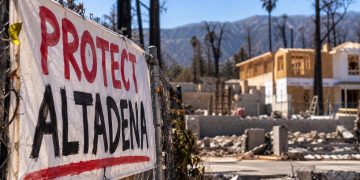








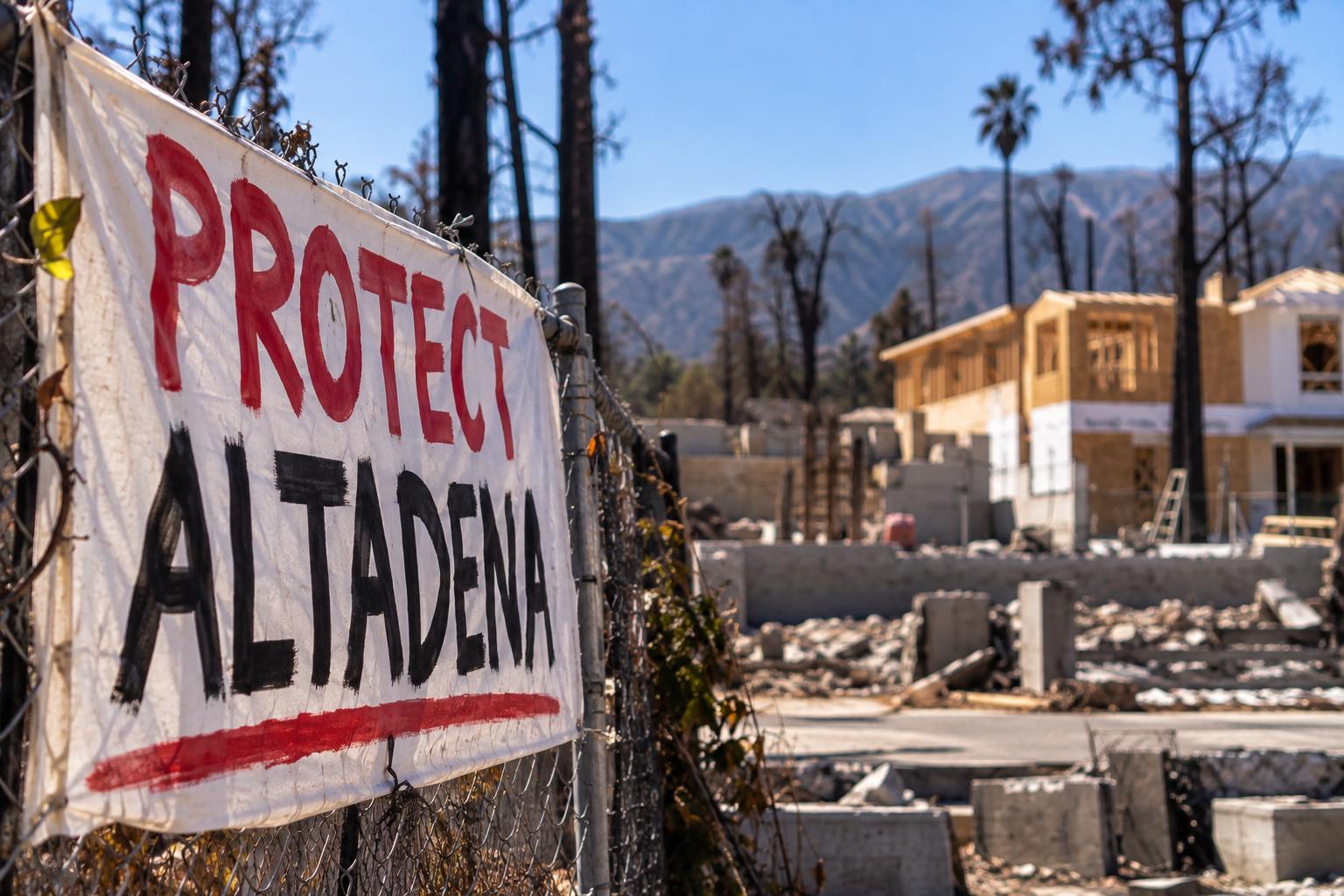
LOS ANGELES, CA – Altadena residents rebuilding after the Eaton Fire are now working under a new state law intended to give homeowners more time to recover before certain housing development rules can be used to increase density in the community.
Governor Gavin Newsom signed Senate Bill 1090 on Sept. 30, making the legislation effective immediately as an urgency statute.
The measure, authored by state Sen. Sasha Renée Pérez of Pasadena, applies specifically to Altadena and changes how certain housing development projects and urban lot splits are processed in the Eaton Fire-affected community.
The legislation received overwhelming support in Sacramento. The final Senate vote was 37-0, with three senators not voting, while the Assembly approved it 76-0, with three members not voting, according to the bill’s legislative history.
What SB 1090 actually changes
The new law does not create a blanket ban on all multifamily housing construction in Altadena.
Instead, SB 1090 temporarily removes certain state-mandated ministerial approval requirements for qualifying housing development applications and subdivision maps in ZIP codes 91001 and 91003.
Those provisions apply to applications submitted on or after Oct. 1, 2026, and remain in effect until Jan. 1, 2030, under the enacted legislation.
In practical terms, the law gives local officials greater discretion over certain projects that otherwise could have qualified for streamlined approval under state housing laws.
The legislation specifically addresses housing development projects and urban lot splits, two areas that have become part of the debate over how Altadena should rebuild after the January 2025 wildfire.
The California Legislature’s official bill information identifies the measure as legislation concerning planning and zoning, housing development projects, urban lot splits and subdivisions in Altadena following the Eaton Fire.
Survivors say rebuilding should come first
For residents who lost homes in the Eaton Fire, the timing of the legislation is closely tied to the difficulties of rebuilding.
Altadena community activist Shawna Dawson, who lost her home in the fire, was among those pushing for the legislation.
Dawson argued that residents should have an opportunity to rebuild their own properties before major changes in neighborhood density take place.
“We desperately need this to protect our community,” Dawson said.
She also pointed to insurance disputes as one of the reasons many homeowners remain unable to move forward.
“The majority of people in Altadena cannot rebuild or even start rebuilding until they get through litigation and settle their claims with their insurance companies,” Dawson said.
The insurance challenges are taking place alongside the broader rebuilding process, which involves permits, debris removal, financing, temporary housing and decisions over whether properties can be reconstructed on their previous footprints.
County says rebuilding is already underway
The scale of the recovery remains substantial.
The Los Angeles County Planning Department’s Eaton Fire recovery program says the fire began Jan. 7, 2025, and significantly affected unincorporated Altadena and surrounding areas.
The county has established special procedures for homeowners whose properties were damaged or destroyed.
For qualifying “like-for-like” rebuilds, the county says replacement structures generally must remain within the same size, location and land-use framework as the legally established structure that was destroyed, subject to specified modifications.
For projects that go beyond those parameters, different development standards apply.
The county also provides expedited recovery procedures, fee relief and other tools through its disaster recovery and rebuilding program.
That means the rebuilding process is not simply a matter of obtaining a conventional construction permit. Survivors may also have to navigate insurance claims, financing and additional disaster-related requirements before construction can begin.
The debate is about what Altadena looks like after rebuilding
Supporters of SB 1090 say the legislation gives fire survivors more control over the character of their community during an unusually disruptive period.
The concern is that state housing laws could allow certain properties to be divided or developed at greater density before residents have had an opportunity to rebuild their own homes.
The issue has particular significance in Altadena because the Eaton Fire destroyed thousands of structures and displaced residents across the community.
The Los Angeles County Fire Department reported in August that the Eaton Fire killed 19 people and destroyed or damaged more than 9,000 homes and businesses.
The department’s investigation concluded that electrical arcing events involving an out-of-service Southern California Edison transmission tower caused the fire.
For residents still dealing with the consequences, however, the cause of the fire is only one part of the recovery. The larger question is how the community will be rebuilt and what it will look like when that process is complete.
County officials support the new law
Los Angeles County Supervisor Kathryn Barger, whose district includes Altadena, welcomed Newsom’s signing of SB 1090.
In a statement from her office, Barger said the law gives Eaton Fire survivors greater certainty as they navigate the rebuilding process.
Barger also said the legislation could help residents avoid displacement following the disaster.
The measure’s supporters have framed the issue around giving homeowners time to recover rather than permanently preventing housing development.
That distinction is important because California continues to face a significant housing shortage, while Altadena residents are simultaneously dealing with a disaster that destroyed existing housing stock.
SB 1090 therefore places the rebuilding needs of a specific wildfire-affected community against the state’s broader effort to increase housing production.
Rebuilding remains difficult for many homeowners
Even with permitting reforms and new legislation, rebuilding remains financially difficult for many survivors.
Los Angeles County officials have previously pointed to insurance payments and access to capital as major obstacles.
In February, Supervisor Barger said that 53% of impacted residents had taken no action to rebuild, with many lacking the capital needed to move forward and delayed insurance payments contributing to the problem.
The state has since introduced additional financial assistance.
In September, Newsom announced a new $100 million state recovery program designed to help close gaps between insurance payments and rebuilding costs for eligible wildfire survivors.
The program was developed specifically in response to feedback from survivors of the Eaton and Palisades fires.
That funding is separate from SB 1090, but both measures address different parts of the same recovery problem: helping homeowners return while communities determine how reconstruction should proceed.
Disaster case management funding also faced a deadline
At the same time that SB 1090 was being signed, fire survivors were facing uncertainty over another important recovery resource.
The Disaster Case Management Program, or DCMP, provides individualized assistance to survivors dealing with FEMA applications, insurance claims, temporary housing, rebuilding plans and other recovery needs.
The California Department of Social Services describes DCMP as a FEMA-funded program that pairs disaster survivors with case managers to identify unmet needs and develop comprehensive recovery plans.
The program serving survivors of the Eaton and Palisades fires had been facing a major funding deadline on Sept. 30 because California had not received all of the previously approved federal funding.
That situation changed on the same day Newsom signed SB 1090.
FEMA released $6.6 million in previously approved funding for the program serving survivors of the January 2025 Los Angeles-area fires, according to a Sept. 30 announcement from the Los Angeles County Coordinated Joint Information Center.
The county said the funding would support case management services for more than 3,000 survivors affected by the 2025 California wildfires and straight-line winds in Los Angeles County.
A fourth installment of the original federal award remained pending.
The state had also amended its agreement with case-management providers to allow services to continue through Oct. 31, according to federal lawmakers who announced the new funding.
Survivors still face a long recovery
The new law does not resolve the broader challenges facing Altadena homeowners.
Residents must still deal with insurance claims, construction costs, financing, permitting and the practical difficulties of rebuilding properties after a fire that destroyed thousands of structures.
The county says rebuilding is already underway and continues to provide recovery resources and rebuilding information for affected residents.
For supporters of SB 1090, the legislation provides a temporary window in which homeowners can focus on recovering without certain streamlined development rules automatically determining how properties in the affected ZIP codes can be developed.
For opponents of additional restrictions, the broader housing crisis remains an important consideration, particularly as California continues working to increase housing production.
For now, SB 1090 gives Altadena a defined period in which qualifying projects will not receive the same automatic ministerial treatment under the specified state housing provisions.
The law took effect immediately on Sept. 30 and applies to qualifying applications submitted beginning Oct. 1, 2026, with the temporary provisions scheduled to remain in place until Jan. 1, 2030.