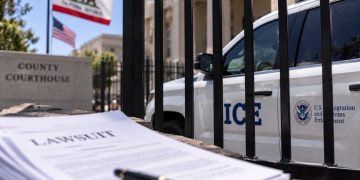









LOS ANGELES, CA – Three Southern California plaintiffs are seeking to amend their federal lawsuits after California Gov. Gavin Newsom signed a new civil-rights law that creates a state-law path for people to seek damages when federal officials allegedly violate rights protected by the U.S. Constitution.
Senate Bill 747, authored by state Sen. Scott Wiener, was signed Sept. 29 and immediately became law as an urgency statute. The measure, commonly referred to as the “No Kings Act,” adds Section 53.8 to the California Civil Code and applies retroactively to claims arising on or after March 1, 2025.
The legislation comes as California and the federal government continue to clash over immigration enforcement, particularly following expanded federal operations in Southern California.
Three plaintiffs seek to use new law
According to court documents provided for the cases and statements from attorney Maria F. Garcia Baldizzone, three U.S. citizens are seeking to amend lawsuits involving alleged encounters with federal immigration officers in Southern California.
The plaintiffs include Javier Ramirez of East Los Angeles, Cary Lopez and a third man whose case involves allegations arising after he recorded federal immigration officers interacting with young people.
The allegations have not been established in court, and the federal officers identified in the lawsuits have not been found liable for the conduct described by the plaintiffs.
Ramirez alleges that federal agents confronted him on his property, physically restrained him and took him into custody. He says he identified himself as a U.S. citizen during the encounter.
According to Ramirez’s account, one of the officers allegedly referred to him as Mexican before he was taken into custody. Ramirez also says he was not provided access to an attorney or medical treatment during the detention.
The allegations are contained in litigation and statements from the plaintiff and his attorney, rather than findings by a court.
Pregnant woman alleges she was thrown against vehicle
A second plaintiff, Cary Lopez, alleges that immigration officers detained her when she was nine months pregnant.
Her attorney says Lopez was pushed or thrown against a vehicle during the encounter despite being close to giving birth.
Lopez was later released, according to the account provided by her attorney. Her legal claims also allege that the encounter contributed to trauma surrounding the premature birth of her child.
Those allegations remain disputed and have not been adjudicated.
The third plaintiff alleges that he began recording federal immigration officers who were speaking with young people before officers arrested him. His attorney says the encounter resulted in injuries to his arm, shoulder and back that required hospital treatment.
Together, the cases are being presented by the plaintiffs’ attorney as examples of the types of claims the new California law is intended to address.
What the No Kings Act actually changes
The new law is broader than immigration enforcement alone.
Under SB 747, a natural person who, under color of law, deprives a California citizen or another person within the state’s jurisdiction of rights, privileges or immunities secured by the U.S. Constitution can be subject to a civil action for redress.
The law also provides for attorneys’ fees in qualifying cases and allows a court, at its discretion, to award costs to a prevailing plaintiff.
The measure is specifically aimed at creating a state-law cause of action for constitutional violations involving government officials.
That distinction matters because the law does not simply declare that every federal agency can be sued in California state court. The enacted language creates liability for a qualifying natural person and separately states that existing sovereign-immunity defenses are not waived.
The legislation also addresses immunity defenses. A defendant can assert absolute or qualified immunity, but the law limits those defenses to the same extent they would apply to a person sued under specified federal law under similar circumstances.
Law applies retroactively to March 2025
One of the most significant provisions is the law’s retroactive application.
SB 747 specifies that its provisions apply to conduct occurring on or after March 1, 2025. The legislation therefore potentially reaches claims based on events that occurred before Newsom signed the measure.
The statute also establishes a two-year limitation period for actions brought under the new provisions, measured from when the cause of action accrues.
Because the law took effect immediately, plaintiffs with qualifying claims do not have to wait for a future effective date before attempting to use the new cause of action.
That immediate effect is particularly relevant to the three Southern California cases described by Garcia Baldizzone, because the plaintiffs are seeking to incorporate the new legal theory into existing litigation.
California says the law addresses a gap in federal remedies
Wiener and supporters of SB 747 argued that federal law has become increasingly difficult to use when people seek damages from federal officials for alleged constitutional violations.
A California Senate Judiciary Committee analysis said federal law provides a cause of action under 42 U.S.C. Section 1983 for certain constitutional violations committed under color of state law, but that Section 1983 does not itself provide the same route when the defendants are federal officials.
The analysis also described the measure as creating a state-law cause of action for constitutional-rights violations by government officials and noted that the bill was designed to operate retroactively.
Wiener has argued that the legislation is intended to ensure that people in California have a mechanism to seek damages when federal officials violate constitutional protections.
Newsom’s office listed SB 747 among a package of immigration-related measures signed Sept. 29. The governor’s office described the legislation as part of a broader effort to protect California residents from what it characterized as aggressive federal immigration enforcement tactics.
Federal government disputes California’s authority
The new law is already drawing a legal and political response from federal officials.
According to the information provided for the cases, U.S. Attorney Bill Essayli criticized the legislation after it was signed and argued that California does not have authority to regulate federal agents.
That disagreement goes to the heart of the emerging legal conflict.
California’s law creates a state-law remedy for alleged constitutional violations, but federal officers may still invoke applicable immunity defenses and other protections. The statute itself expressly preserves sovereign immunity that may otherwise be available to a party.
Any dispute over whether a particular lawsuit can proceed, which defendants can be held liable and which defenses apply will ultimately be decided through the courts.
The legislation comes amid broader immigration enforcement disputes
SB 747 was enacted as California lawmakers approved a series of measures addressing federal immigration enforcement.
The governor’s Sept. 29 announcement included several other bills dealing with immigration-related issues, including protections involving courthouses, civil detainees, detention facilities, law-enforcement practices and immigration detention.
The package reflects the widening conflict between California officials and the federal government over how immigration enforcement is conducted inside the state.
For residents who say they were subjected to unlawful searches, seizures, excessive force or other constitutional violations by federal officials, however, the practical question is narrower: whether the new state cause of action can provide a viable path to damages in an individual case.
What happens next in the three cases
The three plaintiffs described in the lawsuits are now attempting to amend their existing litigation to rely on the newly enacted California statute.
Their claims still must proceed through the court system, where the allegations can be challenged and evidence evaluated.
The plaintiffs will have to establish that the conduct alleged violated rights protected by the U.S. Constitution and that the defendants fall within the scope of the new statute. Defendants can raise applicable immunity and other legal defenses.
The California Legislature’s official bill record identifies SB 747 as Chapter 752 of the Statutes of 2026. The law was approved by Newsom on Sept. 29 and filed with the Secretary of State the same day.
For the three Southern California plaintiffs, the immediate significance is that their attorneys now have a newly enacted state-law provision to cite in litigation involving alleged constitutional violations by federal officials.
For California more broadly, the cases could become an early test of how far the new law can reach and how it will interact with federal immunity rules and the federal government’s authority over its officers.