







LOS ANGELES, CA – Officials are warning Southern California residents to brace for two powerful storms set to bring heavy rainfall, high winds, and a heightened risk of flooding and mudslides, particularly in areas recently scorched by wildfires. State and local emergency crews have been mobilized in preparation for the severe weather, with Governor Gavin Newsom overseeing response efforts in vulnerable regions.
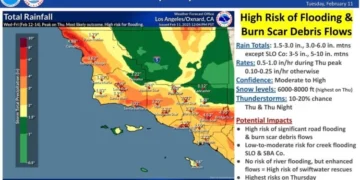
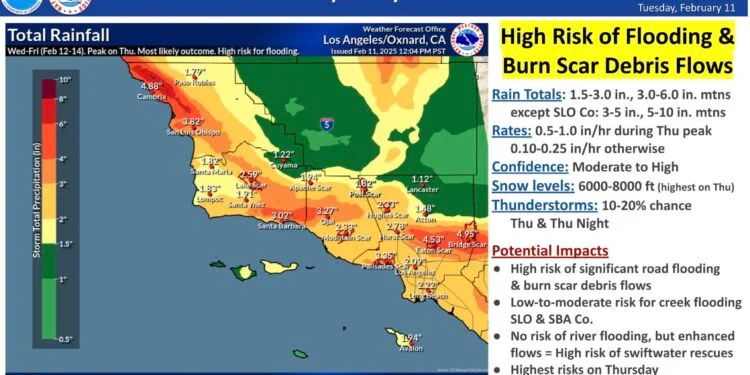
The first storm is expected to arrive Wednesday, bringing up to half an inch of rain. A stronger system will follow Thursday night, potentially dumping up to three inches across the region and as much as six inches in foothill communities. Wind gusts could reach 30 mph, and rainfall rates may exceed one inch per hour near thunderstorms, according to the National Weather Service.
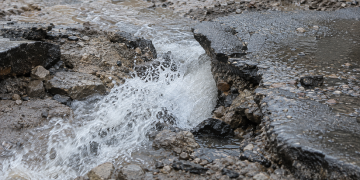
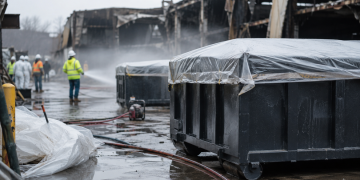
Officials are particularly concerned about burn scar areas in Pacific Palisades and Altadena, where recent wildfires have left the ground vulnerable to dangerous debris flows. Burned soil can form a water-resistant crust, increasing the risk of flash flooding and mudslides.
Governor Newsom visited the Eaton Fire burn area in Altadena on Tuesday to inspect emergency protection measures. Crews have installed containment barriers and other flood mitigation materials to prevent debris from overwhelming waterways.
“California has been in a constant state of readiness preparing for extreme winter weather,” Newsom said. “Crews have been on the ground for weeks working to secure areas against possible mudslides and debris flows.”
The state has deployed significant resources to assist at-risk communities, including:
- More than 319,000 sandbags and 5,600 super sacks prepositioned across Southern California.
- 242 CAL FIRE engines available statewide for rapid response.
- Over 400 emergency personnel stationed across eight counties.
- Nearly 120 miles of protective barriers installed to control debris flow.
- 70 National Guard soldiers with heavy engineering equipment assisting with debris removal.
Caltrans has been closely monitoring conditions along major highways, including Pacific Coast Highway and Topanga Canyon Boulevard, where rockslides and mudflows pose significant risks. Crews have been working to install erosion control devices in key areas, while a team of 14 geologists is analyzing burn scars to predict potential debris flow locations.
Additional emergency resources include:
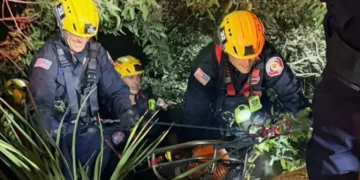
- Eight swiftwater rescue teams on standby.
- Eight bulldozers and five helicopters prepared for rapid deployment.
- Five heavy rescue teams positioned across the state.
- Thirty watershed protection specialists monitoring conditions.
- Multiple incident management teams ready to coordinate local response efforts.
The California Department of Social Services is working with local organizations to set up shelters and warming centers for those displaced by flooding, while the Department of Public Health is supporting healthcare facilities in areas expected to be impacted.
Beyond immediate flood risks, the storm system is expected to bring broader disruptions, including urban flooding in Southern California, strong winds capable of knocking down power lines, and heavy snowfall in Northern California, where snow levels could drop to 2,000 feet.
Authorities are urging residents, especially those living in burn scar areas, to prepare emergency “go-bags” and review evacuation plans in case conditions deteriorate rapidly. Officials also warn against driving through flooded roads and recommend staying indoors during periods of high winds.
“If you’re in the storm’s path, please remain vigilant and follow all guidance from local authorities,” Newsom said.
The storm preparations come as part of the state’s broader efforts to manage winter weather impacts. Last month, Newsom signed an executive order directing agencies to maximize storage of excess water from winter storms to help with future drought mitigation.
The Los Angeles County Department of Public Works is offering free sandbags at multiple locations. Officials from the Federal Emergency Management Agency (FEMA) are also advising residents to consider purchasing flood insurance through the National Flood Insurance Program.
More information on state recovery efforts and emergency preparedness is available at ready.ca.gov, while residents affected by recent wildfires in Los Angeles can find specific resources at CA.gov/LAfires.