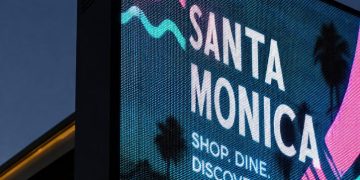



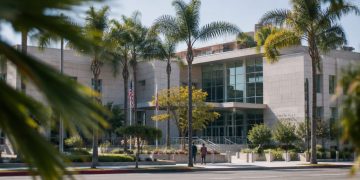
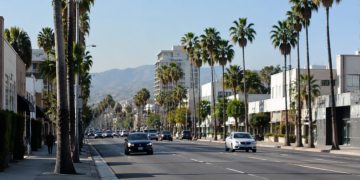

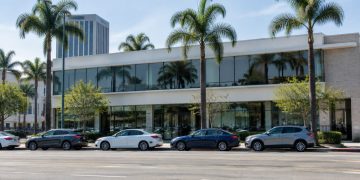




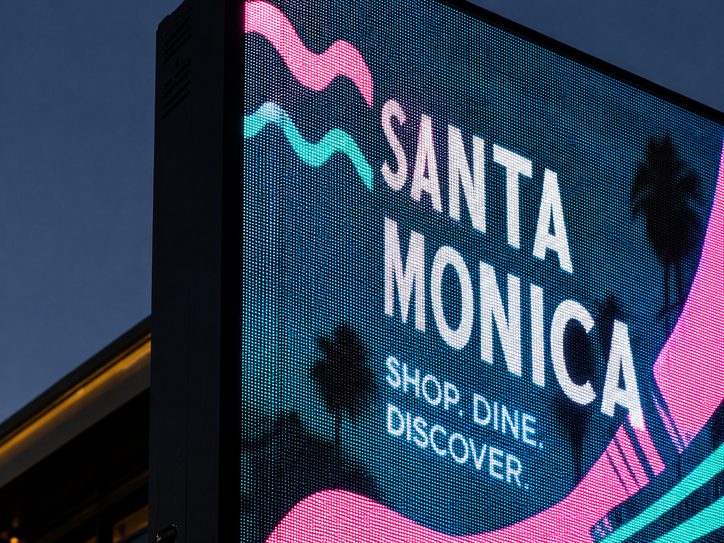
SANTA MONICA, CA – Large digital billboards are beginning to transform the visual landscape of Santa Monica’s Third Street Promenade, ending decades of restrictions on off-premises advertising and dividing residents over whether the new displays will help revive downtown or erode the beach city’s character.
At least two large digital displays are now operating above the Promenade, with additional installations potentially bringing the total to as many as 16.
The change follows a major shift in city policy.
Santa Monica had prohibited off-premises advertising, including billboards, since adopting its Sign Code in 1985. In December 2025, the City Council adopted a new Digital Display District Ordinance allowing large-scale digital advertising at specified locations along Third Street Promenade and at Santa Monica Place.
The city describes the district as an effort to support the long-term economic success of downtown while creating new opportunities for commercial advertising, civic announcements, public art, local events and emergency notifications.
But for some residents, the first screens have already gone too far.
“This is not Las Vegas, or New York. This is a quiet beach town and I think it looks very ugly,” Santa Monica resident Mary Boyer said.
Boyer said the scale and brightness of the displays feel out of place in a coastal community.
“That’s too big. We don’t need that for a beach town,” she said.
Another resident, Houman Hemmati, said the change goes beyond the appearance of individual advertisements.
“When you add light-up billboards to make the place look like Times Square, all of a sudden you dramatically change the character of a place and you change it from something quiet and sleepy to something flash, loud, and always on,” Hemmati said.
Those concerns closely mirror issues the city itself considered when crafting the ordinance.
Santa Monica says the new rules were designed to prevent an excessive concentration of signs, establish limits on their size and locations, impose lighting standards and create operating rules covering hours, sound, motion and energy efficiency.
The displays are not allowed everywhere in Santa Monica.
The new district is specifically focused on Third Street Promenade and Santa Monica Place, which the city describes as one of its most important commercial, entertainment and economic areas.
Under the ordinance, large digital displays must generally be attached to buildings rather than installed as freestanding billboards. Regulations also limit where they can be placed and how far they can project from building facades or rooflines.
First Displays Begin Operating
The city has already identified the first two major display locations near the northeast corner of Arizona Avenue and Third Street Promenade and the southwest corner of Wilshire Boulevard and Third Street Promenade.
One approved project at 1310 Third Street Promenade, for example, involves a roughly 1,000-square-foot full-motion digital display mounted to the corner of an existing building and capable of showing both on-premises and off-premises advertising.
The city also requires part of the available display time to be reserved for public-oriented programming.
Santa Monica has launched an Art in Motion Program, or AMP, that uses portions of the screens’ daily operating schedule to show moving-image artwork by local and national artists. Other display time can be used for city initiatives, events and public alerts.
The displays may operate roughly 19 to 20 hours per day, depending on the season.
Homelessness Message Draws Attention
One of the first messages displayed on the new screens was an advertisement for The People Concern, a nonprofit organization that works with people experiencing homelessness across Los Angeles.
That choice immediately drew attention from some residents.
“These showed up and the messaging is curious to begin with, that that’s the first place we go,” resident Shaun Rosenberg said.
Hemmati also questioned why a homelessness-related message appeared among the earliest advertisements on screens being promoted partly as an economic tool.
“Why would they have an ad, in all things right here, when you want to try and make money off these billboards. None of that makes sense,” he said.
The People Concern, however, said it did not pay for the placement.
“The billboard space featuring The People Concern was provided to us at no cost, so no donor or program funds were used to purchase the advertising space,” the nonprofit said.
The organization said the donated advertising gave it an opportunity to increase awareness about homelessness and services without diverting funds from its programs.
“Opportunities like this allow us to raise awareness about homelessness and the work being done across Los Angeles to connect people with housing and supportive services, while reaching audiences we may not otherwise reach,” the organization said.
“We’re grateful for opportunities that allow us to increase awareness of our work without taking resources away from the services we provide to our community.”
The advertisement was no longer appearing in the rotation Monday, while other commercial messages remained visible.
Not Everyone Opposes the Change
Some residents welcomed the new displays.
“I like it a lot. It’s bright, it’s large,” said one resident identified as Bob.
“I hope it will refresh the neighborhood a little bit. It could work,” he added.
That argument reflects one of the city’s central goals for the program.
Santa Monica has spent several years changing zoning and business regulations downtown in an effort to make Third Street Promenade more flexible and economically competitive.
In 2024, the City Council expanded allowable signage and loosened other commercial rules as part of a broader strategy to attract businesses and increase activity downtown.
The new digital display district goes considerably further by reintroducing large-scale off-premises advertising after decades of prohibition.
City Sees Revenue Opportunity
Santa Monica expects the displays to generate substantial new revenue.
The ordinance specifically calls for revenue sharing or other financial contributions from digital-display operators to support reinvestment in downtown and city services.
The source material provided for this report says city officials believe the program could generate millions of dollars annually if the broader network of displays is developed.
The city’s official materials confirm that revenue generation and economic reinvestment are explicit objectives of the program, though they do not provide a single citywide annual revenue figure on the public overview page.
That financial argument is especially important as Santa Monica works to strengthen its downtown economy.
The city has highlighted signs of renewed activity on Third Street Promenade in 2026. During FIFA World Cup events this summer, Santa Monica reported more than 100,000 attendees, a roughly 40% increase in Promenade foot traffic and a similar increase in downtown and beach parking revenue during the initial event period.
Those figures are not directly attributable to the billboard program, but they demonstrate why city leaders continue to focus heavily on bringing people, businesses and spending back to the downtown district.
Debate Is Likely to Continue
For critics, the economic argument does not resolve the aesthetic question.
Rosenberg said he understands why Santa Monica wants additional revenue but worries that the city could sacrifice qualities that historically distinguished it from more commercially saturated entertainment districts.
“They say this is an attempt to try and make money. I get that in theory,” Rosenberg said. “The question is, who are they making money from? And I think it takes away a polish, an aesthetic, and a culture that the city is built on.”
That tension is likely to become more visible as additional applications move through the approval process.
Santa Monica’s planning materials show approved and pending development agreements for digital displays within the designated district, meaning the two screens currently visible represent only the beginning of what could become a considerably larger network.
Each display remains subject to city review and the operating standards established by the ordinance.
For residents walking beneath the first screens, however, the broader policy debate has already become tangible.
After nearly four decades in which traditional off-premises billboards were prohibited, Santa Monica is experimenting with a very different vision for Third Street Promenade — one built around brighter advertising, public programming and new revenue.
Whether that ultimately helps revive downtown or changes the character residents value about Santa Monica is now at the center of the debate.