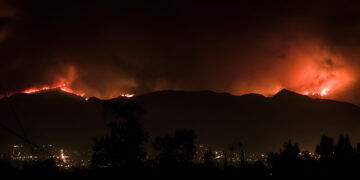








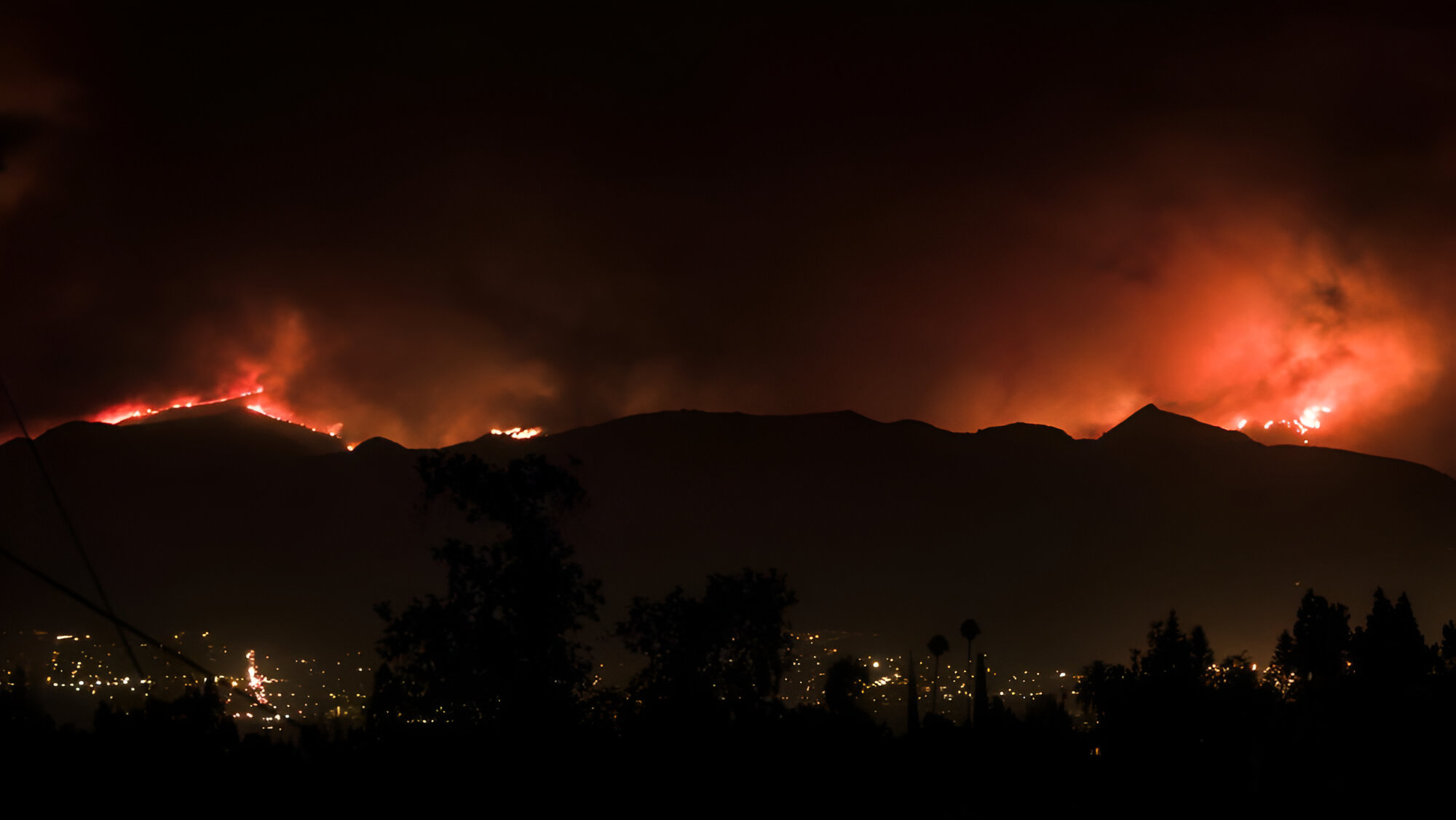
LOS ANGELES, CA – The financial cost of the Palisades Fire is staggering, with homes, businesses, and infrastructure reduced to ash. Yet the emotional toll exacted on the victims of this catastrophic blaze is incalculable. Unlike property, which can be valued in dollars and cents, the personal losses endured by those who have seen their lives upended defy any such measure.
Photographs taken by authorized news helicopters surveying the devastated area have drawn comparisons to images of Hiroshima after the atomic bombing in 1945. Even Los Angeles County Sheriff Robert Luna described parts of the city as looking like “an atomic bomb dropped.”
Palisades Village, while not technically the fire’s origin point, has become an epicenter of destruction and heartbreak. After navigating numerous security checkpoints along the Pacific Coast Highway and turning into Temescal Canyon Road, the scale of the devastation becomes impossible to ignore. Abandoned, incinerated cars line the roadside, while utility crews work to repair dangling power lines.
Entering the Village itself, the destruction grows even more surreal. The once-bustling area is now a ghost town. Landmarks like the Shell gas station are little more than scorched husks, and partially burned buildings, like the Gelson’s supermarket, appear as if they were bombed.
Every street, from Sunset Boulevard to Via De La Paz, is a tableau of ruin: charred homes, smoldering debris, and a landscape painted in shades of gray. The air carries the acrid smell of smoke, and fractured water pipes trickle continuously, providing an eerie soundtrack to an otherwise silent, post-apocalyptic scene.
The destruction is punctuated by the occasional sound of firefighting planes roaring overhead, their mission to suppress the blaze still underway. Burned-out cars litter the streets, their melted frames pooled with once-molten metal. The occasional remnant of a brick chimney or a warped metal sculpture offers faint clues to the homes that once stood there.
As displaced residents began to trickle back into the area for the first time, the emotional devastation was palpable. Some came to see if their homes had somehow been spared. Others came to document the destruction for insurance purposes.
“It’s gone. All gone,” said resident Tom Hershaw, struggling to hold back tears. Hershaw’s family narrowly escaped the fire when it tore through the area. “We were lucky because my son is at St. Matthew’s, and the fire started right above that. At 10:30, we got the notice to get the kids. I was at work in the Valley, my wife was at work, and our nanny was here,” he recalled.
“They weren’t even evacuating yet, but [the nanny] saw the smoke and went to get both kids. That’s when all the chaos happened. I came back, and it was full-on crazy. The cops let me take my dog, and that was it. We have two cars, thankfully, and these clothes. That’s about it. But we’re all safe.”
Gail McMahon, another resident who returned to survey the damage, expressed concerns about navigating the rebuilding process. “I don’t know how they’re going to handle [the insurance claims],” she said. “I don’t have confidence…they’re going to find a way to underpay, right? For sure.”
For many residents, the emotional weight is compounded by uncertainty about the future. A man named Sean admitted that his family was unprepared for such a disaster. “You always think it’s never going to happen to you—until it does,” he said. “It’s going to be five years, or more, before it starts resembling what it was. But I just hope people take this opportunity to build it back smarter and that the government helps us make the infrastructure more fire-resilient.”
Elsewhere along the Pacific Coast Highway, once-iconic spots like the Reel Inn, a beloved seafood restaurant, were reduced to rubble. The remains of the Pacific Palisades Bowl Mobile Estates, where 170 units once stood, were similarly unrecognizable. Former residents Rachel McDonald, John Bouton, and Jeff Garris stood in disbelief as they surveyed the scene.
“We’re still in shock,” McDonald said. “You just want to actually see it…you want to see the dead body, smell the dead body. Metaphorically speaking.” Despite their losses, the group expressed hope that their close-knit community would help them recover.
Yet the road ahead is long and uncertain. For many, insurance coverage is limited or nonexistent, leaving federal aid programs like FEMA as their only hope for rebuilding. Others, like Bouton, are focused on simply rebuilding the basics. “What’s next?” he said, laughing bitterly. “A shower—and to buy underwear and socks.”
The personal devastation echoes far beyond the burn zones. Even residents living outside mandatory evacuation areas wrestle with newfound fears. For some, the fire has sparked existential questions about material possessions and priorities. For others, it’s the sobering realization that lives can be upended in moments, leaving only the clothes on their backs.
The challenges ahead are staggering. Rebuilding entire communities will require years of effort, billions of dollars, and significant political will. Meanwhile, residents must also contend with secondary disasters, such as potential mudslides in the months ahead when rains return to hills stripped bare of vegetation.
The Palisades Fire is already being called one of the most devastating wildfires in Los Angeles history. Its aftermath has left scars that go far beyond the physical destruction. Like other disasters, from Hurricane Katrina to the 9/11 attacks, the recovery will require resilience, unity, and hope. Whether Los Angeles rises from the ashes stronger and more prepared for the future remains to be seen.