



LOS ANGELES, CA – The long-delayed Skylink people mover at Los Angeles International Airport has become a central issue in the mayoral race between Mayor Karen Bass and City Councilmember Nithya Raman, who face each other in the Nov. 3 general election, according to statements from both candidates and Los Angeles World Airports records.
The 2.25-mile elevated train was approved in 2018 with a construction budget of about $1.9 billion and a completion date of March 31, 2023. Its contractor, LAX Integrated Express Solutions, known as LINXS, now says service will not begin before January 2027 and that cost overruns have pushed the price above $3.3 billion.
Raman says Bass’s airport commissioners approved a $550 million payment to the contractor in 2024 and that the promised start of service in January 2026 never came. Bass says the project’s problems began before she took office and that her administration pushed for a settlement to set a firm finish line.
The train is designed to carry travelers between airline terminals and ground transportation as Los Angeles prepares to host the 2028 Summer Olympic Games. Los Angeles World Airports, known as LAWA, has said it will not compromise on safety testing.
Train links terminals, parking and transit
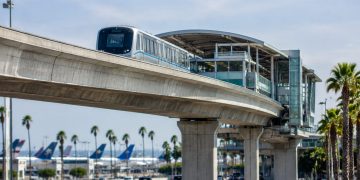
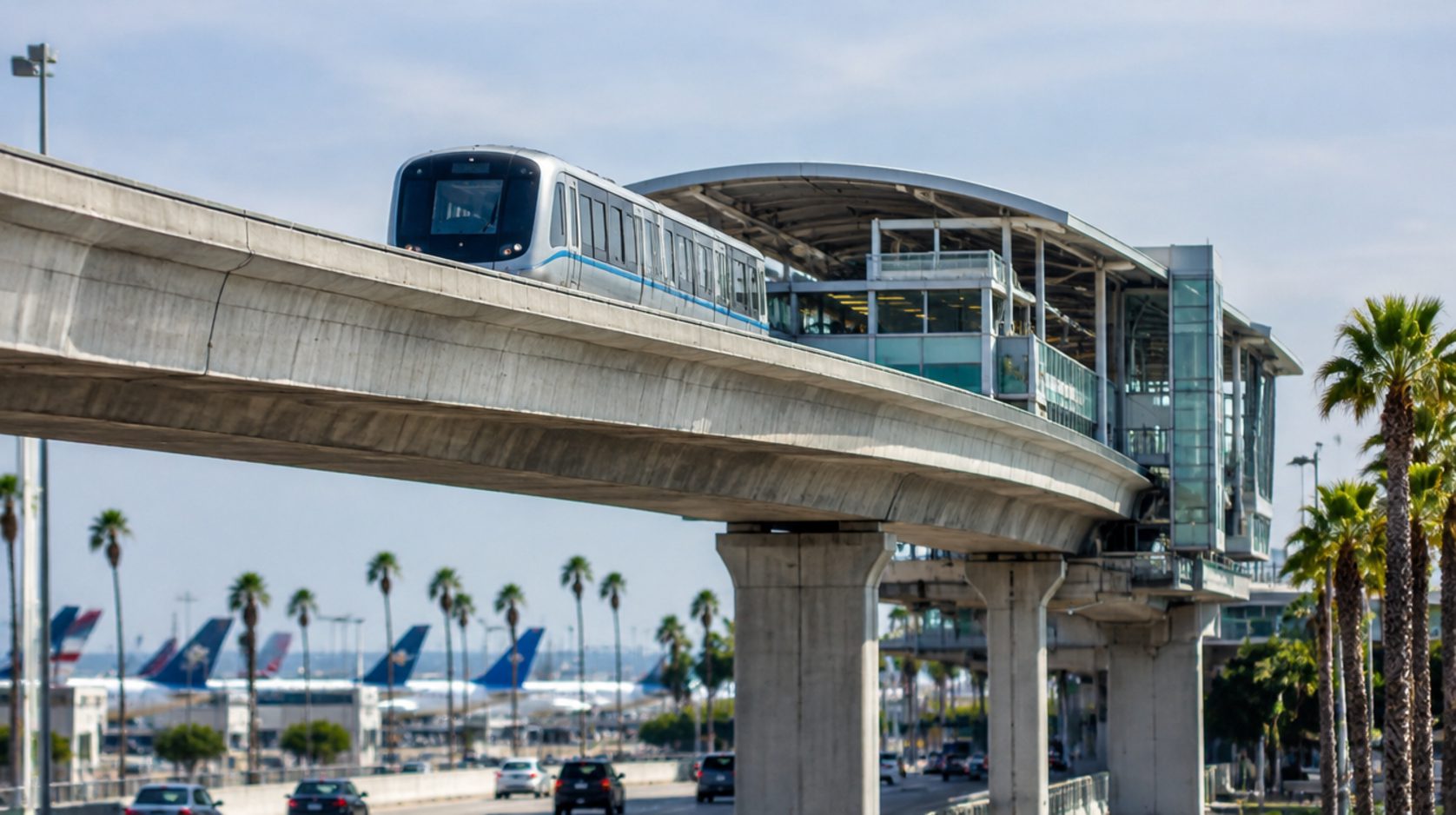
According to LAWA’s project page, SkyLink features a 2.25-mile elevated guideway with six stations, three inside the Central Terminal Area and three outside it. The train is meant to provide access to the terminals, parking, pickup and drop-off curbs, the LAX Rental Car Center and Metro light rail and bus lines.
LAWA anticipates about 30 million passengers a year will use SkyLink, with an estimated result of more than 42 million fewer vehicle miles traveled annually. The page describes peak service with nine four-car sets, each carrying up to 200 passengers and luggage.
The page lists construction as starting in 2019.
2024 agreement set Dec. 8, 2025 completion date
The Los Angeles Board of Airport Commissioners approved an agreement with LINXS on July 18, 2024 that set a construction completion date of Dec. 8, 2025, LAWA said in a news release.
Under the agreement, LINXS was to be paid an additional $550 million, “largely to cover already completed extra work dating back to August 2018 and a longer than anticipated construction timeline,” according to the release. The agreement also appropriated an additional $50 million for contingencies.
The release said the train would begin full operations in January 2026, run around the clock and carry 30 million passengers a year. It said the train would be free for ticketed passengers, guests and airport employees.
The January 2026 start of service did not happen. The contractor now says Skylink will not be running until January 2027 at the earliest.
Raman faults Bass’s airport commissioners
Raman said in a statement that over two years ago, when the project was already a year behind schedule, Bass’s airport commissioners cut a $550 million check to cover project cost overruns and to secure a start of service in January 2026. She said that date came and went and that Bass has not said how she will get the project on track.
In campaign messaging, Raman has said that if elected she would seek investigations of the contractor by the city attorney and the state attorney general. She has also said contractors like these would never get a dollar from the city again.
Bass says problems predate her term
Bass said in a statement that the project and its problems began before she took office and that “we pushed for a settlement so there would be a firm finish line.”
“I expect LAWA and the contractor to finish this job and get riders on board,” Bass said.
In a separate statement, the mayor said, “I look forward to this being done so we can safely and efficiently move Angelenos and visitors to our world-class airport in the new year.”
LAWA says safety testing will not be compromised
LAWA said in a Sept. 24 statement to reporters that “The safety and absolute reliability of the SkyLink train are our highest priorities.” The agency said rigorous, exhaustive testing is standard industry practice and that it would not compromise on these safety protocols.
On lenders’ deadlines and financing, LAWA said it does not intend to comment on private financing arrangements, lender discussions, contractual milestones or rating agency decisions involving the LINXS consortium.
According to initial reports, LINXS set completion for Dec. 8 in a Sept. 16 disclosure filing. After that date, the train must pass 30 days of testing, an independent review and an assessment by LAWA before opening to passengers.
LINXS also sued the city in July over a payment dispute, according to initial reports.
Rideshare fees tied to Skylink activation
On March 10, the Board of Airport Commissioners approved an adjustment to drop-off and pick-up costs for rideshare companies at LAX, the first in more than 10 years, LAWA said in a news release. Rideshare companies will be charged $12 per ride for central terminal access and $6 per ride, up from $4, at the Ground Transport Center.
“Implementation of the new fee structure will coincide with SkyLink’s activation,” the release said. David Reich, LAWA’s deputy executive director for mobility strategy, said rideshare companies profit heavily from LAX while their fees stayed unchanged for more than a decade.
Raman has made the fee increase part of her campaign. She has said that instead of fighting the cost overage, Bass is making people who use the airport pay for it.
$289 million federal grant targets airport roads
LAWA was awarded a $289 million Federal Aviation Administration grant for new airport access roadways, according to a LAWA news release dated Aug. 7. U.S. Transportation Secretary Sean P. Duffy announced the award.
The grant covers roadway construction rather than the train. It supports new ingress roadways into LAX that separate airport traffic from local traffic, as part of the Airfield and Terminal Modernization Program Roadway Improvements Project, which reconfigures 4.4 miles of roads.
The release said the new roadways are expected to “significantly reduce congestion on Sepulveda Boulevard.” Ingress roadways are expected before the 2028 Summer Olympics, and full egress roadway completion is expected by 2030. LAWA has received more than $368.6 million in FAA Airport Infrastructure Grants for fiscal years 2022-26.
Metro plans for 1 million extra daily trips
Metro estimates one million extra trips per day during the 2028 Games and says it is working with partners to expand the transit network to meet that demand, according to Metro’s page on the 2028 Games. Its main goal is to enable all ticketed spectators to travel to competition venues by public transit, walking or cycling.
The page also describes a temporary Games Enhanced Transit Service to augment existing service for spectators and the workforce.
Election date is Nov. 3
Bass and Raman, who both advanced from the June primary, will appear on the Nov. 3 ballot. Skylink’s opening remains tied to the contractor’s projection of January 2027 at the earliest, and LAWA has said it will not compromise on safety testing before the train carries passengers.