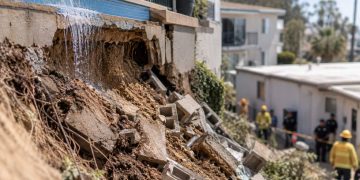










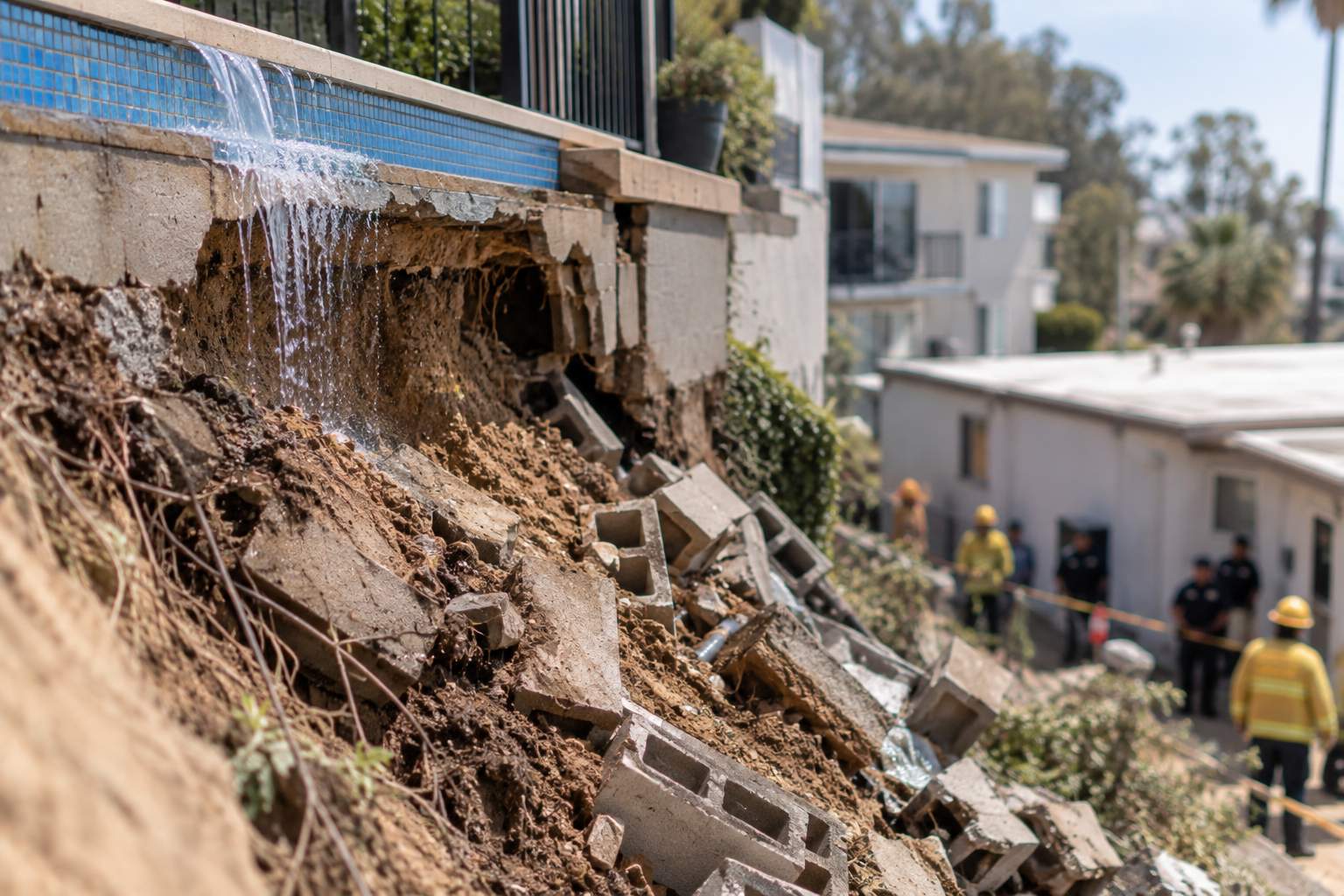
LOS ANGELES, CA – An overflowing swimming pool triggered a partial hillside collapse in the Hollywood Hills, sending portions of a retaining wall down the slope and through the roof of a vacant building while forcing the temporary evacuation of eight apartment units.
The incident was reported Friday, Sept. 18, in the 1900 block of North Wilcox Avenue. The Los Angeles Fire Department said the scene was later stabilized, with residents who had been evacuated allowed to return to their homes. No injuries were reported.
According to LAFD, the reported source of the flooding and hillside collapse was a garden hose that had been left filling a swimming pool above the slope. The pool overflowed for an unknown period, sending water into the hillside and contributing to the instability.
The incident illustrates how water accumulation can become a serious concern on a steep residential property, particularly when saturated soil places additional pressure on structures supporting a slope.
About 7,000 gallons of water removed
Firefighters responding to the scene found that the overflowing pool had saturated the hillside.
LAFD Capt. Milo Cope said crews estimated that approximately 7,000 gallons of water had accumulated in the pool. Firefighters used siphon injectors to remove the water over roughly 90 minutes.
Cope said the water represented approximately 56,000 pounds of weight that was bearing on the ground beneath the pool.
Once crews began removing the water, the response shifted toward reducing the immediate pressure on the slope and protecting the structures below.
LAFD reported that its fire crews and Urban Search and Rescue teams were also working to shore up the building below the hillside while the pool was being drained.
Retaining wall breaks apart
The water-saturated hillside placed additional pressure on a retaining wall, portions of which failed.
Cinder blocks from the wall broke loose and traveled down the slope before striking the building below. Some of the blocks went through the roof of the lower structure.
The building was vacant at the time, meaning no occupants were inside when the debris came down. LAFD reported that no injuries were associated with the collapse.
The damage was significant enough for city officials to restrict access to both the damaged structure and the pool area.
The Los Angeles Department of Building and Safety is responsible for building inspections and enforcement within the city. Its residential inspection services include assessments involving swimming pools and retaining walls, among other residential structures.
Eight apartment units evacuated
Because the damaged slope was located below an apartment building on Grace Avenue, authorities initially evacuated eight units as a precaution.
The concern was that additional movement of the hillside or retaining structure could potentially affect the apartment building above the collapse.
LAFD said LADBS was called to assess the structural stability of the apartment building. After that assessment, officials determined that the building was stable and not in danger of collapsing.
Residents were subsequently allowed to return to their homes.
The evacuation was therefore precautionary rather than the result of a reported structural failure of the apartment building itself.
Damaged building and pool area red-tagged
While residents of the apartment building were permitted to return, the damaged structure at the base of the hill remained subject to restrictions.
LAFD said LADBS red-tagged portions of the damaged structure and the pool area after the emergency response. The department’s guidance explains that a red tag is used when a building or portion of a structure is considered unsafe to enter or occupy.
LADBS also maintains inspection and property-record systems that allow the public to review building, permitting and code-enforcement information for properties in Los Angeles.
The city’s building department has specific guidance addressing slope failures. Its published information states that after a slope failure is inspected, LADBS can notify the property owner and that Los Angeles Municipal Code provisions require slope failures to be repaired within a specified period, subject to the applicable circumstances and extensions.
Emergency response winds down
The initial response involved multiple LAFD units as well as Urban Search and Rescue personnel. LAPD and LADOT also assisted with scene management during the evacuation and stabilization effort.
Once the pool had been drained and the structural assessment completed, LAFD reported that the scene had become static and that no further department updates were expected.
The incident remained focused on structural safety and damage assessment rather than a medical emergency, with no injuries reported.
For residents and property owners dealing with damaged buildings or suspected structural hazards, LADBS provides inspection, enforcement and property-record resources through its official website. The department also accepts reports involving potential building-code violations and other hazards.
The investigation and structural assessment will determine what additional work is required at the property, while the apartment residents who were temporarily displaced have been allowed to return.