










LOS ANGELES, CA – Street vending has become a sharp policy divide in Los Angeles’ mayoral race, with Mayor Karen Bass calling for limits on where vendors can operate near restaurants while Councilmember Nithya Raman argues that the city should focus on making permits easier to obtain and bringing more vendors into the regulated system.
The disagreement centers on a familiar Los Angeles tension: street vendors are widely recognized as part of the city’s food culture and economy, but restaurant owners say unpermitted operators can compete from sidewalks without carrying the same rent, permitting, labor and facility costs imposed on brick-and-mortar businesses.
Bass has publicly supported street vending while arguing that location still matters.
During a recent mayoral debate, she said she does not believe a food vendor should be positioned directly in front of a restaurant.
Raman has taken a different approach, saying the city should concentrate on reducing barriers that discourage vendors from entering the permitting system in the first place.
Her argument is that increasing the number of legal vendors would also make the industry easier to regulate.
The debate comes against a permitting system that is more complicated than simply obtaining one city license.
Under the City of Los Angeles Sidewalk Vending Program, anyone selling food or merchandise on a city sidewalk or in a city park must obtain a Sidewalk & Park Vending Permit from StreetsLA.
Those permits must be renewed every 12 months.
A vendor applying for the city permit must also obtain a City of Los Angeles Business Tax Registration Certificate and a California seller’s permit. Food vendors generally must additionally secure a health permit from the Los Angeles County Department of Public Health.
That overlapping system helps explain why the number of vendors operating on Los Angeles sidewalks can be dramatically larger than the number appearing in official permit records.
Information provided in connection with the mayoral debate estimated roughly 50,000 street vendors operating across Los Angeles, while city figures from September 2024 showed only 687 active vending permits.
Of those, just 53 were active food-vendor permits.
Those figures are historical snapshots rather than a current 2026 count, but the gap is central to the political dispute.
Raman has argued that such a low participation rate suggests the permitting process itself needs improvement.
In 2024, she was involved in an effort that reduced the annual city sidewalk-vending permit fee to $27.51, a substantial change intended to lower one financial barrier facing vendors.
But the city permit is only one part of the process.
Food vendors face separate county health requirements
For prepared food vendors, Los Angeles County public-health rules add another layer.
The Los Angeles County Department of Public Health regulates many sidewalk food vendors as Compact Mobile Food Operations, or CMFOs.
The category was created after California Senate Bill 972 changed the state Retail Food Code beginning in 2023.
Depending on what a vendor sells and how food is prepared, a CMFO may need a public-health permit, an approved cart design, plan review and periodic inspections.
County health officials say food carts that handle unpackaged food generally require a health permit, while limited exemptions exist for vendors selling only certain prepackaged, nonperishable foods or whole uncut fruits and vegetables from small operations.
For permitted carts, inspections are required.
Los Angeles County says the frequency depends on the operation’s risk category: lower-risk carts may be inspected once every two years, while higher-risk operations can receive two routine inspections each year.
That regulatory framework speaks directly to one of the concerns raised by restaurant owners: food safety.
Restaurants operate under detailed requirements involving refrigeration, food handling, sanitation and inspection.
Permitted sidewalk food businesses are also subject to health standards, although their physical requirements differ because they operate from compact mobile facilities rather than permanent kitchens.
County public-health officials warn that food sold by unpermitted vendors carries additional risk because those operations have not gone through the same health-permit and inspection process. The county specifically identifies unsafe food temperatures, unapproved food sources and cooking outside an approved mobile food facility as examples of noncompliant operations.
That does not mean every unpermitted vendor is serving unsafe food, but it explains why increasing participation in the permitting system has become a priority for both regulators and advocates.
Raman argues permitting can improve enforcement
Raman’s position is that a more accessible legal pathway can improve regulation rather than weaken it.
She has said Los Angeles should make it easier for vendors to obtain permits and has pointed to assistance programs designed to help people navigate the process.
“We wanted residents of this city to know we’re not attacking street vendors, we really want to celebrate them,” Raman said.
Asked about the small number of active food permits reported in 2024, she said the city needed to make the process easier.
“I think we need to make sure it’s easy for people to get these permits,” Raman said.
Her argument is that vendors who enter the permitting network become easier for the city and county to regulate.
“And actually bringing more people into the permitting network helps us regulate them better,” she said.
The official StreetsLA rules support part of that framework: vendors must obtain a city permit, renew it annually and maintain the underlying registrations necessary to operate legally.
Food sellers may also face county inspections once permitted.
Bass draws a line at restaurant entrances
Bass has framed the issue less around whether street vending should exist and more around where it should occur.
Her position is that vendors should not be allowed to operate immediately in front of established restaurants.
“I do not think you should have a food vendor in front of a restaurant,” Bass said during the debate.
That argument reflects concerns from some restaurant owners who believe sidewalk vendors can draw customers while avoiding many of the fixed costs associated with a permanent business.
Bass has nevertheless emphasized that she considers street vending an important part of Los Angeles.
Her office has described it as a significant source of income for thousands of Angelenos and part of the city’s food identity.
The administration also said it has directed LAPD away from criminal enforcement against vendors and has worked to address criminal citations that were issued improperly.
The larger policy question, however, is whether protecting vendors from criminalization should also be paired with more restrictive placement rules.
That is where Bass and Raman are more clearly divided.
Existing city rules already regulate where vendors can operate
Los Angeles does not currently treat sidewalks as unrestricted commercial space.
The city’s vending program contains rules governing placement, pedestrian access and safety.
StreetsLA states that its vending permit exists in part to protect the “health, safety and welfare” of residents and visitors, and the city maintains separate rules addressing accessibility under the Americans with Disabilities Act.
The city can issue administrative citations when vendors operate without required permits.
StreetsLA’s current public FAQ says vendors operating without proper permits may face fines ranging from $250 to $1,000.
Los Angeles County has its own enforcement authority for food operations lacking required health permits.
Public Health says an initial notice of violation can be followed by administrative penalties, and since 2024 enforcement agencies have been able to assess penalties of up to three times the applicable permit cost for continued operation without a required health permit.
That means the policy debate is not about whether regulations exist.
It is about whether Los Angeles should add or strengthen location-based protections for restaurants and how aggressively authorities should enforce existing requirements.
Restaurant owners say costs are unequal
Some restaurant owners argue that the current balance is unfair.
Nicolas Montano, who owns a restaurant in Chatsworth, said traditional establishments carry costs that many sidewalk vendors may not.
“Obviously they don’t pay the same fees, rents, and permits and stuff,” Montano said.
He also raised concerns about food preparation when operators lack refrigeration or hand-washing facilities.
Those concerns overlap with the county’s own health requirements.
For unpackaged food, Los Angeles County publishes specific construction and operational rules for CMFO carts. The requirements depend on what food is being prepared, but approved operations may need equipment for safe food storage, handwashing and other sanitation measures.
County officials say carts must go through plan review when required and receive final approval before a public-health permit is issued.
The existence of those rules makes the difference between permitted and unpermitted vendors important.
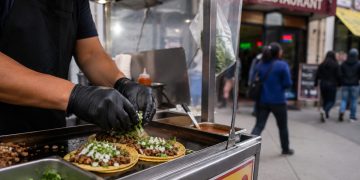
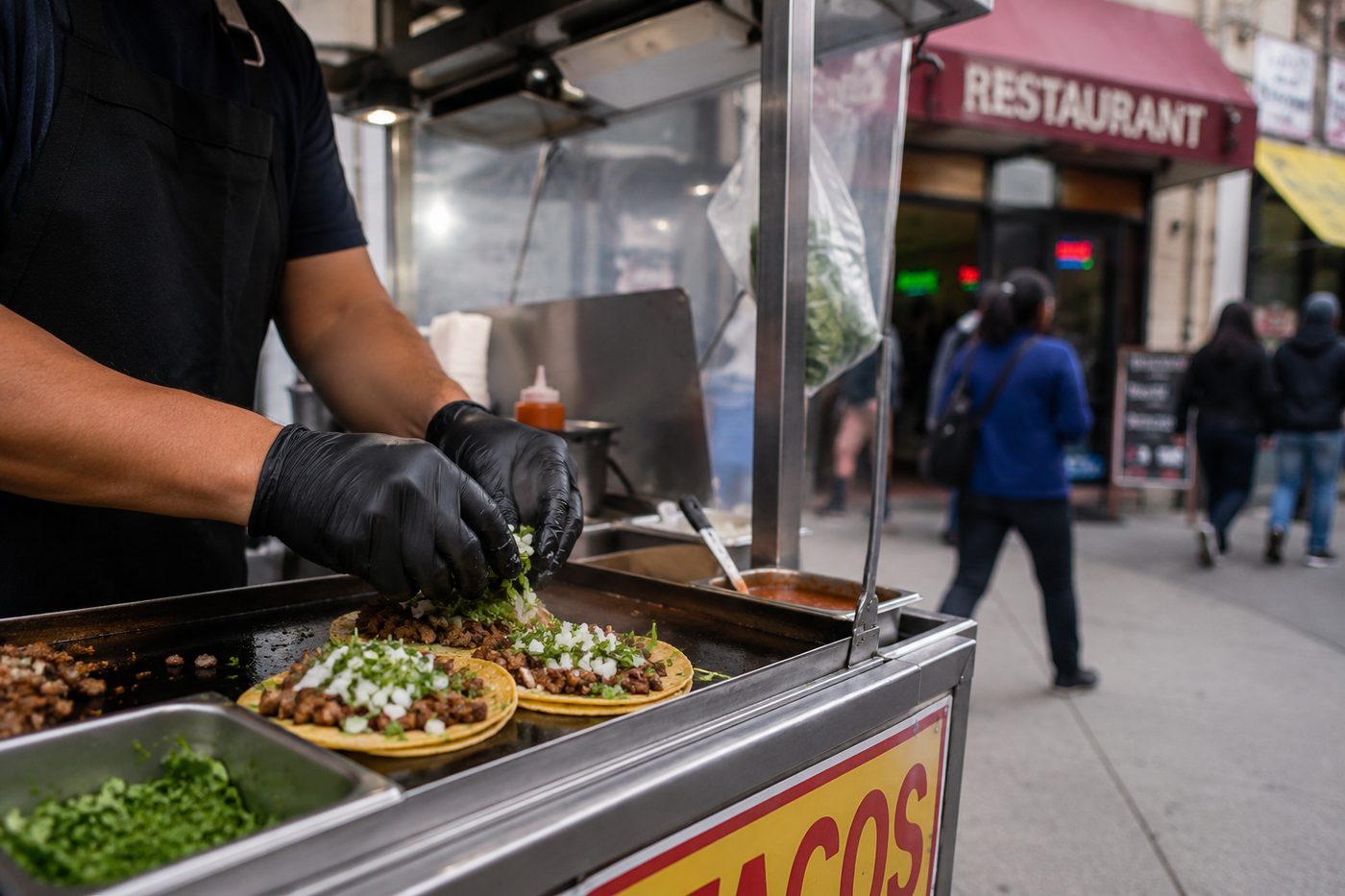
A permitted sidewalk taco vendor and an unpermitted operation are not operating under the same regulatory circumstances.
Bass administration points to vendor assistance
Bass’ administration says its approach has included financial assistance rather than enforcement alone.
According to information provided by the mayor’s office, the city has invested millions of dollars into its Sidewalk Vending Cart program, including nearly $500,000 during the current fiscal year.
The program is intended to help vendors establish or expand compliant businesses.
That kind of assistance addresses another obstacle in the permitting debate: equipment.
Food carts that meet health requirements can be considerably more sophisticated and expensive than improvised sidewalk setups.
California’s reforms under SB 972 were specifically intended to make legal food vending more attainable by creating the CMFO category and reducing some structural requirements that previously made permitting especially difficult for small vendors.
But even with those changes, a food vendor may still need to navigate city registration, state tax requirements, county health approval and equipment standards.
That is the bureaucratic environment Raman argues should become easier to navigate.
Debate reflects two different definitions of fairness
At the center of the disagreement are two competing ideas of fairness.
For Bass and restaurant owners seeking greater location protections, fairness means ensuring a vendor cannot set up immediately outside a business that pays rent, taxes, permit fees and substantial overhead.
For Raman and vendor advocates, fairness means making sure people with limited capital are not effectively excluded from legal entrepreneurship because the permitting process is too expensive or complicated.
Those positions are not necessarily incompatible in every respect.
Both camps have expressed support for legal street vending.
Neither side is calling for a return to the era when vending itself was broadly treated as a criminal offense.
The disagreement is over how Los Angeles should regulate a legalized industry that remains far larger in practice than the official permit system suggests.
The permit gap remains the biggest challenge
If the estimate of tens of thousands of Los Angeles vendors is even approximately correct, the number participating in the formal system remains small.
The September 2024 figures cited in the debate — 687 active permits overall and 53 for food vendors — illustrate that problem.
Current StreetsLA guidance still makes clear that anyone selling food or merchandise on Los Angeles sidewalks or in city parks needs a vending permit.
For food vendors, county requirements can apply on top of that.
The Los Angeles County Department of Public Health says a CMFO selling unpackaged food or performing limited preparation generally requires a public-health permit, with specific exemptions only for certain low-risk food sales.
That makes legal operation a multi-agency process rather than a single application.
Whether city leaders simplify that system further could become one of the most consequential street-vending policy questions of the next mayoral administration.
Enforcement remains politically sensitive
Any expansion of enforcement is likely to generate its own controversy.
Street vending in California was decriminalized in large part because advocates argued previous enforcement disproportionately harmed immigrants and low-income entrepreneurs.
That history helps explain why city officials now tend to discuss administrative regulation, education and permitting assistance rather than criminal prosecution.
At the same time, public-health officials still have responsibility for food safety, and the city must keep sidewalks accessible and address legitimate complaints from neighboring businesses.
Los Angeles County encourages people concerned about unpermitted food operations to contact its Mobile Food Program and specifically asks complainants to provide the location, time and details of the activity.
That enforcement system exists independently of the mayoral debate.
The political question is how heavily Los Angeles should rely on it.
Street vending moves deeper into mayoral campaign
The issue has now moved beyond a technical discussion about permits.
It has become a visible distinction between Bass and Raman as they make their cases to Los Angeles voters.
Bass is presenting herself as supportive of street vendors but willing to establish boundaries when their operations conflict with brick-and-mortar restaurants.
Raman is emphasizing legalization and access, arguing that a system with very few permitted food vendors is evidence that the government should make compliance easier rather than simply increase enforcement.
Restaurant owners are pressing city leaders not to ignore the economic imbalance they believe exists when an unpermitted sidewalk operation competes directly outside a regulated business.
And vendors continue to navigate a system requiring approvals from multiple levels of government.
For Los Angeles, the debate is ultimately about what legalization should look like after the city has accepted street vending as a permanent part of its economy.
The next phase is less about whether vendors belong on Los Angeles sidewalks and more about where they can operate, how easily they can become legal and how the city balances their livelihoods against the interests of established restaurants.