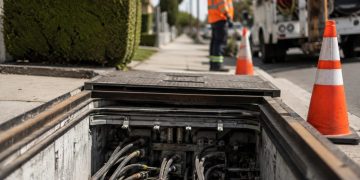









LONG BEACH, CA – More than 26,000 Southern California Edison customers lost power after an underground electrical vault caught fire near Bluff Heights, triggering a widespread blackout that stretched into Monday as crews worked to restore service.
The outage began Sunday afternoon near Broadway after firefighters responded to a fire involving underground electrical equipment.
Long Beach fire officials said no injuries were reported.
According to information released about the incident, the outage initially affected more than 26,000 customers.
Southern California Edison crews restored power to many customers relatively quickly, but a large section of Long Beach remained without electricity overnight.
At one point, more than 16,000 homes and businesses were still without power in an area generally bounded by East Ocean Boulevard to the south, East Seventh Street to the north, Alamitos Avenue to the west and Quincy Avenue to the east.
By Monday morning, the outage had been reduced to roughly 2,500 customers.
At approximately 6 p.m. Monday, 1,371 customers remained without electricity, according to information provided by Southern California Edison.
SCE expected the remaining customers to have service restored by Tuesday morning.
The utility said crews were continuing to investigate the equipment failure that led to the fire.
Although Southern California was experiencing an intense heat wave at the time and high electricity demand was placing additional pressure on the grid, Edison had not formally determined that extreme heat caused the vault failure.
That distinction remains important.
The heat may have contributed to broader electrical stress, but SCE had not completed its investigation into the specific equipment malfunction.
The Southern California Edison Outage Center allows customers to check active outages by service address, meter or outage number and provides updated restoration information as field crews assess damaged equipment.
Customers can also register for SCE outage notifications by text, email or voice call.
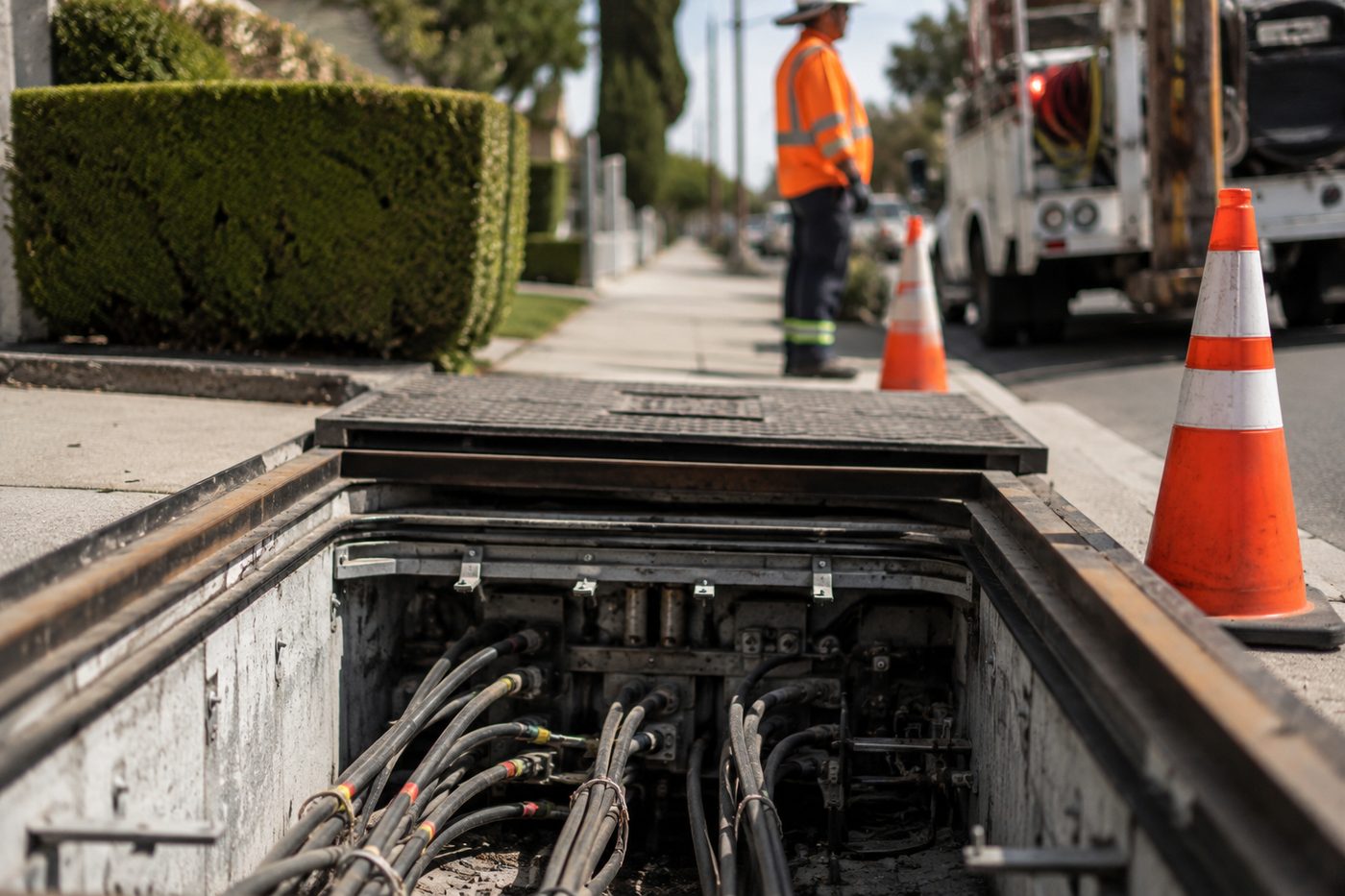
The Long Beach incident involved underground electrical infrastructure rather than overhead wires.
Utility vaults typically contain cables, switches and other components that distribute electricity beneath streets and sidewalks.
When equipment inside a vault fails, firefighters and utility crews may need to deal not only with fire but also with energized electrical components, smoke and restricted underground access.
That can complicate both firefighting and restoration.
Long Beach has experienced significant underground electrical vault fires before.
In July 2015, a separate series of electrical vault fires in downtown Long Beach produced a major outage after firefighters encountered smoke coming from underground vents near Third Street.
That earlier incident ultimately involved three underground vaults and left approximately 4,800 customers without power. The Long Beach Fire Department’s official account said firefighters first extinguished the fire and then supported Southern California Edison while crews ventilated the vaults and worked to identify the electrical problem.
The 2015 incident is separate from Sunday’s outage, but it illustrates the type of response required when underground electrical systems catch fire.
In the latest incident, the outage reached substantially more customers.
The blackout also occurred during one of Southern California’s hottest stretches of the year.
Extreme temperatures can substantially increase electricity demand as homes and businesses rely more heavily on air conditioning.
That demand can place additional stress on transformers, cables and other grid equipment, although the failure of any individual component can have multiple possible causes.
SCE had not publicly attributed the Long Beach vault fire solely to heat.
Customers in the affected neighborhoods reported impacts beyond lighting and air conditioning.
Some residents also lost or experienced degraded cellphone service during the outage.
Large blackouts can affect telecommunications because cellular towers and associated network equipment depend on commercial electricity.
Many facilities have backup batteries or generators, but backup capacity varies by location and can eventually be exhausted during prolonged outages.
By Monday evening, cellphone connectivity appeared to have improved in much of the affected area even while some businesses continued waiting for electricity to return.
The timing of the outage made the loss of power particularly significant.
Southern California was under widespread heat alerts, with some inland communities facing triple-digit temperatures.
Although Long Beach generally remains cooler than inland valleys because of its coastal location, residents without air conditioning can still face uncomfortable or dangerous indoor temperatures during prolonged hot weather.
Power outages during heat waves can be especially difficult for older adults, young children, people with medical conditions and residents who rely on electrically powered medical equipment.
SCE maintains general power outage preparedness information for customers, including outage reporting and safety guidance.
The utility’s emergency outage line is 1-800-611-1911.
SCE also advises people to stay away from downed electrical lines and call 911 if they encounter one.
No downed overhead lines were identified as part of the Long Beach vault fire.
For businesses, a prolonged blackout can create additional problems involving refrigeration, point-of-sale systems, lighting and electronic security.
Restaurants and grocery businesses may also have to discard food if refrigeration equipment remains without power long enough for temperatures to rise beyond safe levels.
Officials had not released an estimate of the economic impact on Long Beach businesses affected by Sunday’s outage.
The city and SCE have also been working on longer-term projects to place additional utility infrastructure underground in some neighborhoods.
Long Beach’s Cherry Avenue Utility Undergrounding project is one example of a broader city partnership with Southern California Edison designed to move overhead electrical infrastructure below ground along selected corridors.
Undergrounding can reduce hazards involving wind, vegetation and overhead wires, but underground electrical systems can still experience equipment failures and fires.
The latest outage underscores that distinction.
The city’s earlier experience with underground vault fires also shows why access and ventilation can become major parts of the emergency response.
Electrical crews may need to wait until firefighters have controlled a blaze and conditions are safe enough before damaged components can be inspected, isolated and replaced.
That process can make restoration estimates difficult during the first hours of an outage.
In Sunday’s incident, SCE was able to restore service to the majority of affected customers before Monday evening.
The number without power fell from more than 26,000 initially to 1,371 by 6 p.m. Monday.
Crews expected the final customers to be restored by Tuesday morning.
The equipment failure itself remained under investigation.
SCE had not announced whether a transformer, cable, switch or another component inside the underground vault was responsible.
The utility also had not said whether equipment would need to be completely replaced or repaired before the vault could return to normal operation.
Separately, SCE was warning some customers elsewhere in Southern California about possible Public Safety Power Shutoffs, or PSPS events, during the broader period of extreme heat and elevated fire danger.
Those planned outages are different from the Long Beach blackout.
A PSPS is a preventive measure in which a utility intentionally de-energizes power lines in areas facing dangerous wildfire conditions.
SCE says the decision to implement a PSPS can depend on factors including strong winds, dry vegetation and low humidity.
The Long Beach outage, by contrast, followed an equipment fire and was not described as a preventive shutoff.
During PSPS events, SCE may activate Community Resource Centers that provide services including drinking water, device charging, portable medical equipment charging and outage information.
Those resources are specifically associated with planned wildfire-related shutoffs and do not necessarily activate during every ordinary equipment outage.
For Long Beach residents still without power Monday night, the immediate focus remained restoration.
SCE crews continued working on the damaged underground system while investigators examined what caused the failure.
No injuries were reported in connection with the vault fire.
Most of the more than 26,000 affected customers had their electricity restored by Monday evening, and the remaining 1,371 customers were expected to regain power by Tuesday morning.
The precise cause of the electrical equipment failure remained under investigation.