


LOS ANGELES, CA – The West Hollywood City Council is scheduled to consider a proposal Monday that would direct city staff to evaluate a version of the Fountain Avenue Streetscape Project that keeps existing on-street parking and omits protected bike lanes, according to the agenda item introduced by Councilmember Lauren Meister.
The proposal is Agenda Item F.5 at the Regular City Council Meeting scheduled for Monday, Oct. 19, 2026. It concerns Phase 1 of the project, which covers Fountain Avenue between La Brea Avenue and La Cienega Boulevard.
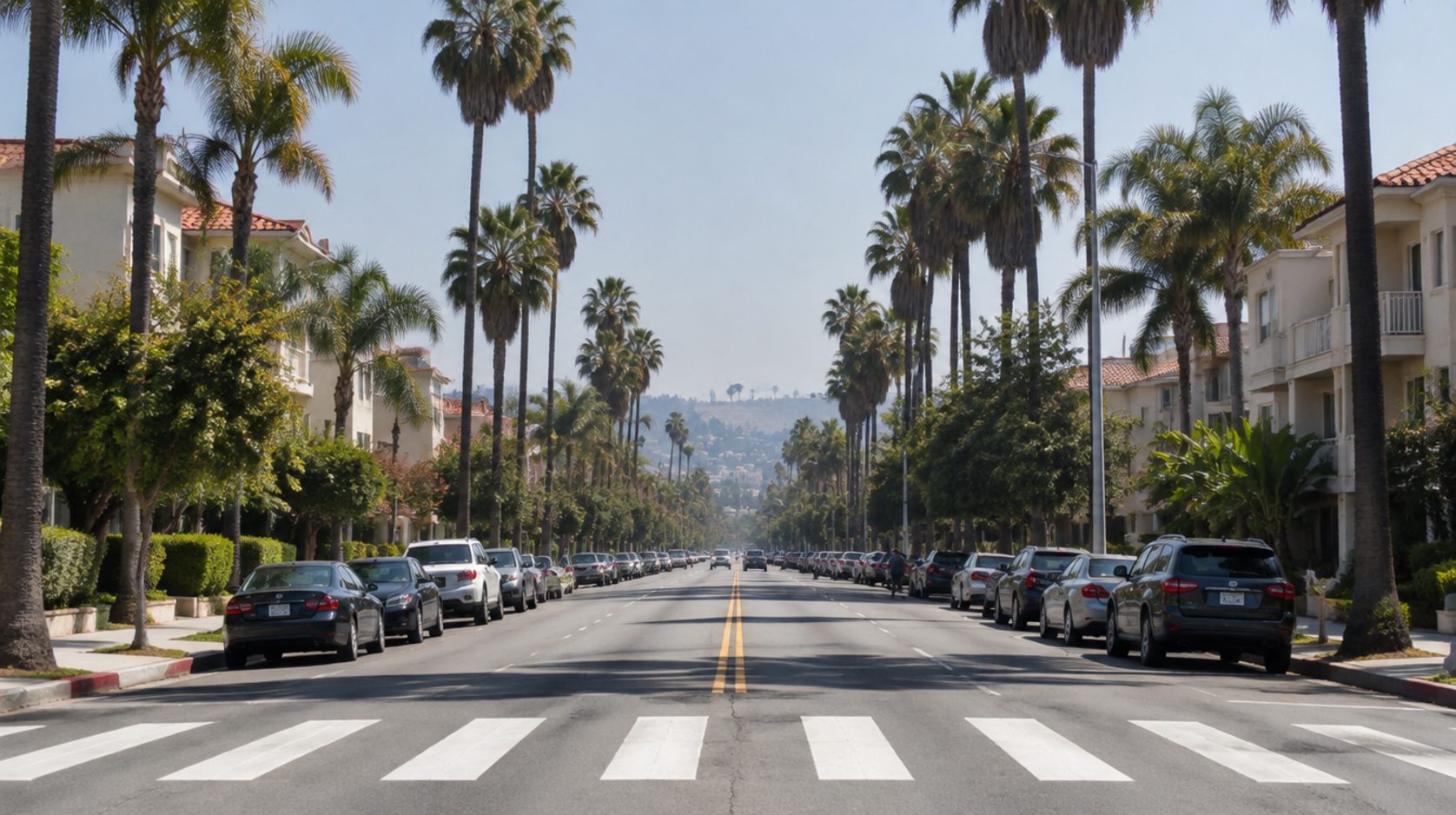
The alternative would have one travel lane in each direction and a center turn lane. Existing on-street parking would stay, and the protected bike lanes in the current design would not be built.
The item does not authorize construction. It asks staff to return to the council with findings on feasibility, safety, costs, scheduling and effects on grant funding.
The council approved a different version of Phase 1, with protected bike lanes, on Sept. 15, 2025, according to the city’s Fountain Avenue Streetscape Project page.
What the alternative design would include
The proposed alternative would not strip the project down to parking alone. It would keep street resurfacing, new striping, high-visibility crosswalks, painted curb extensions and traffic-calming measures.
Those are elements of the plan the council approved last year. The change Meister proposes is to the lane layout: a center turn lane and shared travel lanes in place of curb-separated bikeways, with the existing parking retained.
If the council directs staff to proceed, staff would study the alternative and bring back its findings. According to initial reports, staff would also return for further council direction on Phases 1 and 2.
How the approved plan differs
The design approved in 2025 converts Fountain Avenue from La Brea Avenue to La Cienega Boulevard to one vehicle lane in each direction. The city’s project page says it includes protected bike lanes separated by a concrete curb, high-visibility crosswalks, painted curb extensions on side streets, self-watering planters, repaving and bicycle counters.
Under that plan, curbside parking would remain on the south side of the street only. The city’s project page says Fountain has about 337 on-street parking spaces and that 210 of them would be removed.
The page says Phase 1 construction was anticipated for fall 2026. It says planning for Phase 2 begins in the second half of 2026 and covers ADA curb ramps, sidewalk widening, landscaping, signal changes and utility relocation.
Council voted 3-2 in September 2025
The council’s vote to approve Phase 1 on Sept. 15, 2025, was 3-2, with Meister and Councilmember John Heilman dissenting. Mayor Chelsea Byers and Councilmembers John Erickson and Danny Hang voted in favor. The council took up the item as unfinished business, according to the city’s staff report for that meeting.
The council also approved a $131,040 agreement with the firm Fehr and Peers that night. The traffic-calming measures passed unanimously, while the exemption from the California Environmental Quality Act passed 3-2.
The city’s Transportation and Mobility Commission had reviewed Phase 1 weeks earlier. Its Aug. 20, 2025, staff report on the design was part of the review before the council took its vote.
Positions voiced during the 2025 debate
Byers said at the Sept. 15, 2025, meeting that it was the council’s responsibility to create options for a diverse community. She said vehicle collisions are “the No. 1 contributor to kids’ deaths.”
Erickson said at the same meeting that the process the city had been going through for five years was “killing people.” Hang called Fountain Avenue “one of the most dangerous corridors in our city” and cited “five lives lost” over a decade.
Heilman said he would support an east-west bike lane on Willoughby Avenue instead of the Fountain plan. In 2024, he had called the Fountain plan “incomplete and ill conceived.”
Meister has said she wants a comprehensive streetscape review that covers pedestrian safety, ADA-compliant sidewalks, parking and green space. During the 2025 debate, she questioned the plan’s parking mitigation, asking whether the city was proposing a shuttle for residents who would be left with public parking spots not near their homes.
Fountain on the city’s High Injury Network
The city’s Vision Zero Action Plan page describes the city’s goal of eliminating traffic fatalities and severe injuries. The plan’s High Injury Network includes Fountain Avenue, Santa Monica Boulevard and La Cienega Boulevard.
The Vision Zero designation is one of the contexts in which the Fountain project has been debated. Supporters of the protected-lane design have pointed to the corridor’s collision record, as Hang’s reference to five lives lost shows. Meister’s proposal keeps the pedestrian safety and traffic-calming elements that the original plan carried.
Grant money tied to the project
The Fountain Avenue Streetscape Project is funded in part by a California Air Resources Board Sustainable Transportation Equity Project grant. The city’s Aug. 26, 2024, consent-calendar staff report covered the council’s acceptance of that grant, which includes funds for the Fountain project.
According to initial reports, the grant totals $8,214,840, of which $4,923,840 goes to Fountain Avenue. The proposal before the council on Oct. 19 asks staff specifically to report on how a design without bike lanes would affect that grant funding.
The item does not say whether the grant terms would permit the alternative. That question is part of what staff would be asked to answer if the council directs the study.
Residents asked for a hold on Sept. 1
At the Sept. 1, 2026, council meeting, residents asked the council to put the Fountain plan on hold. They cited parking loss, driveway safety and the city’s outreach. The council took no vote at that meeting.
The city had earlier invited community input on the proposed streetscape project before the council’s 2025 decision.
West Hollywood City Engineer John Gilmore told the council in September, according to initial reports, that staff had studied only options compatible with the protected bike lane design and that no option without a bike lane had been brought forward. Meister’s proposal would direct staff to study one.
Council meets Oct. 19
The council is scheduled to take up Agenda Item F.5 at its meeting Monday, Oct. 19. If it approves Meister’s proposal, staff would evaluate the alternative and return with findings on feasibility, safety, costs, scheduling and grant funding.
Until the council acts, the Phase 1 design with protected bike lanes approved on Sept. 15, 2025, remains the plan the city’s project page describes. The item does not authorize construction under either design.