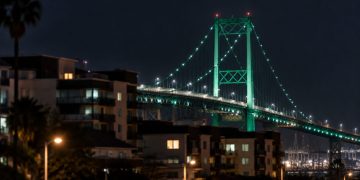









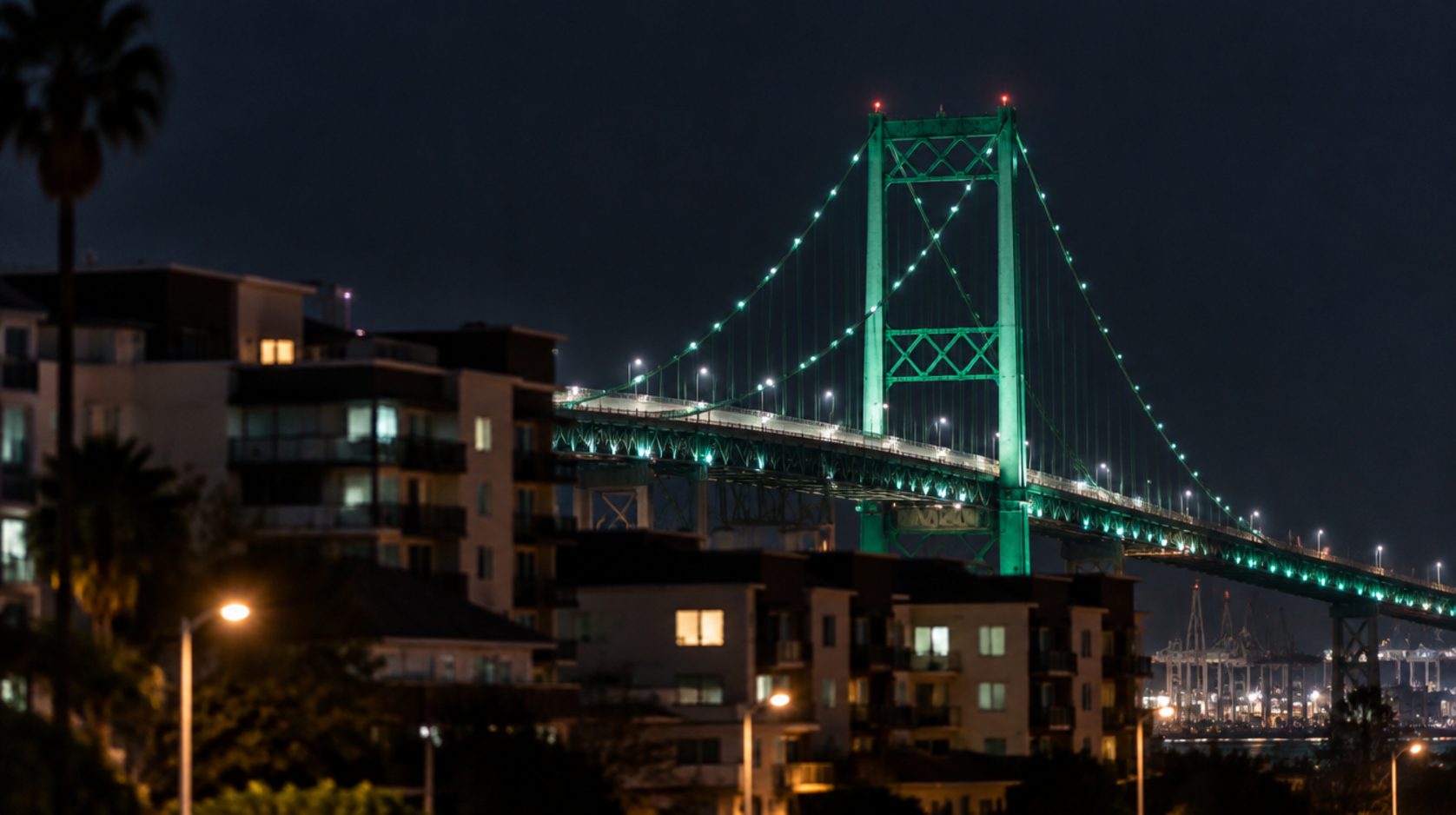
LOS ANGELES, CA – Residents who live near North Harbor Boulevard in San Pedro say overnight construction noise and vibration have made it difficult to sleep since the Vincent Thomas Bridge closed Saturday for a 16-month, $750 million deck replacement, according to a resident and a statement from Councilmember Tim McOsker’s office.
The bridge, State Route 47, closed in both directions at 12:01 a.m. Saturday, Nov. 7, Caltrans said in a news release issued Oct. 22. The agency says the bridge is targeted to reopen in early March 2028.
By Sunday and Monday, Nov. 8 and 9, some residents living near North Harbor Boulevard were complaining about loud overnight work. Alex Denysov, who lives off the boulevard, said the noise became overwhelming after midnight and that vibration can be felt inside his apartment building, especially in units that face the ramp and the bridge.
McOsker’s office said the deck replacement is a Caltrans project and that the council office does not set the state’s construction schedules or working hours. The office said it will monitor the site and talk with Caltrans about additional ways to reduce the noise.
Caltrans says crews are working on the project around the clock. The agency had not released a statement on overnight work hours or noise as of Monday.
Residents describe noise and vibration
Denysov said construction and detours along North Harbor Boulevard near the bridge have been a constant frustration for residents over the past year. He said the start of the bridge project early Saturday brought a sharp increase in noise.
He said that nothing he tried has stopped the sound and that the vibration is noticeable inside the building. Another nearby resident said they made modifications inside their apartment to muffle the noise but could still feel the vibrations.
Denysov said he does not oppose updating the bridge and supports fixing the infrastructure. His concern, he said, is the timing, and he asked that the loudest parts of the construction not be done at night, when people are resting.
Councilmember’s office says it will monitor the site
McOsker, who represents the area on the Los Angeles City Council, responded through his office. “The Vincent Thomas Bridge deck replacement is a Caltrans project, and while our office does not set the state’s construction schedules or working hours, we understand the concerns our residents have raised about overnight noise,” the office’s director of communications said.
The office added that it will discuss the concerns with Caltrans to determine whether there are additional mitigation measures to reduce construction noise for nearby residents.
Before the closure, McOsker’s office addressed the project in a statement on the project’s Final Environmental Impact Report. The page says he raised concerns about air quality, traffic flow, safety, environmental justice and infrastructure in the Harbor Area, and that Caltrans adopted his recommendation for single-stage construction.
In Caltrans’ October release, McOsker said the closure will significantly affect Harbor communities. He said he worked with Caltrans to keep detour traffic out of residential neighborhoods and to secure road repairs and traffic enforcement.
Caltrans says crews work around the clock
Caltrans addresses the work schedule in its frequently asked questions page for the project. “Yes, crews will be working on the project around the clock to complete the project,” the page says.
The 16-month schedule is based on continuous operations, according to the agency. The page lists Caltrans public information officers for questions from the public and a project email address that the agency says is monitored daily.
The agency has said the project was developed over two years with close coordination among cities, community leaders, ports, shipping companies, labor unions and the contractor, the Skanska-CEC Joint Venture.
Closure date moved to Nov. 7
The closure date changed once before it began. On Sept. 25, Caltrans announced a new start date of Saturday, Nov. 7, at 12:01 a.m.
The agency said the new date would have no impact on construction staging. It said the bridge was still targeted to reopen in early March 2028.
Why Caltrans chose a full closure
Caltrans released the Final Environmental Impact Report and Environmental Assessment for the project on Oct. 28, 2024. The document identifies single-stage construction with a full bridge closure as the preferred alternative because it has the shortest construction time and is the safest and most cost-efficient.
Other staging options evaluated in the process included a nighttime-closure option that would have taken about 48 months, according to the agency.
The project’s frequently asked questions page gives a similar explanation. “Based on that feedback process, and for reasons including safety, efficiency, and cost, Caltrans determined the best approach to this project would be a full bridge closure for a shorter period of time,” it says.
Caltrans District 7 Public Information Officer Nathan Bass said Thursday, Nov. 5, that the engagement with residents, port stakeholders and elected officials led to acceptance of the 16-month disruption because the bridge is vital for commerce and transportation. He said the alternatives would have required partial closure of the bridge for much longer than 16 months.
Deck is deteriorating, bridge is structurally sound
The project page says the bridge was built in 1963 and has been in service for more than 60 years. “Although the bridge is structurally sound, the bridge deck is rapidly deteriorating,” the page says.
The total cost is $750 million. The project replaces the entire bridge deck and its seismic sensors and upgrades the railings, fences and median barrier.
A fact sheet for fall and winter 2026-27 says the primary phase will span 16 months from Nov. 7, 2026. It says the work will replace the concrete bridge deck, center median, railing, fencing and signage.
The bridge carries about 53,000 vehicles daily, nearly 9 percent of them heavy trucks, according to Caltrans. In its release, the agency said the investment “will keep our communities connected and commerce moving through the San Pedro Bay Port Complex and the nation.”
Detours and traffic control
Motorists are detoured primarily along Interstates 710 and 110, State Route 103 and Harry Bridges Boulevard, according to Caltrans. The agency said traffic control officers will be deployed to 18 key intersections in the area to monitor and manually facilitate traffic flow, and that local police will expand commercial trucking enforcement.
The fact sheet says a communications effort that includes the QuickMap app will help divert traffic. The release acknowledged the effect on nearby communities, saying that “for 16 months, this closure will have a significant impact on the people who live and work in our Harbor communities.”
The Los Angeles Department of Transportation’s weekly update for Nov. 5 appeared alongside LADOT Transit’s reroute of Commuter Express 142 via Anaheim Street, with free fares during the closure, effective Nov. 7.
Port says terminals remain open
The Port of Los Angeles addresses the closure on its project page. “All Port of Los Angeles terminals will remain open with no expected impact to port operations, cargo terminal productivity, flow or capacity,” the page says.
The Port says about 8 percent of port complex drayage truck traffic uses the bridge. It says detours may add driving time and that rail cargo is unaffected.
Port Executive Director Gene Seroka and Caltrans District 7 Director Gloria Roberts were also quoted in Caltrans’ October release on cargo movement and community preparation.
Bridge targeted to reopen in early March 2028
The deck replacement is scheduled to run through early March 2028, with crews working around the clock. Residents who live near the ramp and the bridge have raised their concerns about overnight noise with the councilmember’s office.
McOsker’s office has said it will discuss possible additional mitigation measures with Caltrans. Caltrans had not announced any change to its work hours as of Monday.
Caltrans lists a project email address, [email protected], for questions from the public. The agency says it is monitored daily.