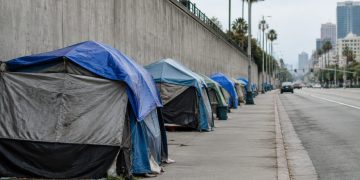


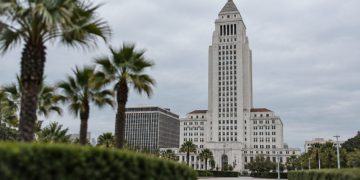

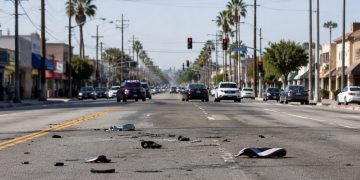

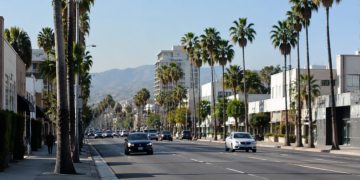


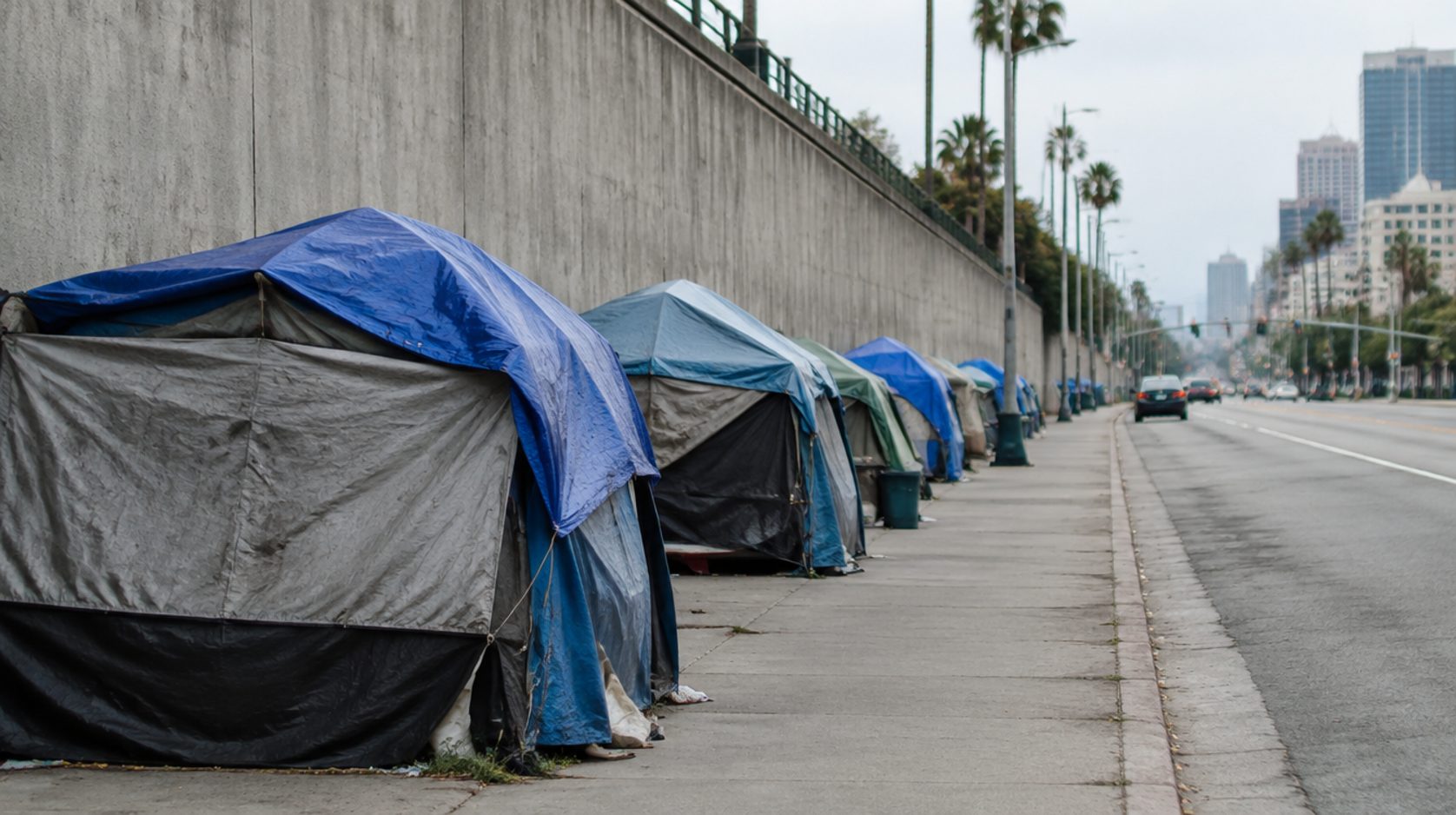
LOS ANGELES, CA – Republican gubernatorial candidate Steve Hilton unveiled a plan Saturday to clear every homeless encampment in California by the end of 2027, proposing a network of recovery centers, enforcement of public camping bans and state intervention in communities that fail to act.
Hilton announced the plan, titled “Off the Streets and Back on,” at a news conference in San Diego on Saturday, Oct. 17. The plan sets a final deadline of Dec. 31, 2027, and the governor’s race between Hilton and Democrat Xavier Becerra is on the Nov. 3 ballot.
“No one is going to get their life back on track living on the streets,” Hilton said at the news conference. “We are going to get people off the streets and into places where they can actually get help.”
The plan is a campaign proposal, and the state has not adopted any part of it. It lands in a policy area where the state already runs encampment removals, treatment funding and spending programs.
Recovery centers are the plan’s centerpiece
The plan proposes a statewide network of Homeless Recovery Centers modeled on the Sunbreak Ranch project in San Diego County. The centers would offer beds, meals, showers, medical care, drug treatment, psychiatric care and job training.
Each person would have someone responsible for helping them reach stable housing, according to initial reports on the plan’s details.
The plan ties the encampment deadline to the availability of these facilities rather than to a date alone. It does not rely on the existing shelter system by itself.
Emergency declaration and camping-ban enforcement
Hilton said he would declare a homelessness emergency as governor to waive permitting barriers. The waiver would apply to the facilities the plan proposes.
He also said public camping bans would be enforced once suitable facilities are available. The plan therefore links enforcement to the capacity of the new centers.
At a separate event at MacArthur Park, Hilton said he would shut down nonprofits that practice harm reduction. He said the backup for people who decline help is the law making it illegal to live on the streets.
Deadlines for mayors and county leaders
In his first month as governor, Hilton said, he would meet mayors and county leaders to set public deadlines for clearing encampments. The campaign set Labor Day 2027 as a milestone for local governments, with Dec. 31, 2027, as the final deadline.
If local governments fail to act, the state would step in, according to the plan. Hilton toured Skid Row in October and described homelessness as a political scandal.
“Operation Zero Waste” would audit homelessness spending
Hilton said he would audit homelessness spending through an effort called “Operation Zero Waste” and redirect money from programs that are failing.
State auditors have examined how homelessness money is tracked. The California State Auditor’s April 2024 report on homelessness found that “numerous entities are involved in funding homelessness prevention, homelessness support services, and the provision of permanent housing in California.”
The report found that nine state agencies spent billions of dollars across at least 30 homelessness programs over five years. It also found that the California Interagency Council on Homelessness had not continued tracking spending after 2023.
At the city level, the auditor wrote that “neither San José nor San Diego tracks and reports in one location, such as a spending plan, all of its funding and spending related to homelessness.”
How the state handles encampments now
California already has an encampment policy that Hilton’s plan would build on or replace. On May 12, 2025, Gov. Gavin Newsom released a model encampment ordinance for cities and counties.
The model includes a ban on persistent camping in one location and a ban on encampments that block sidewalks. It also requires notice and a reasonable effort to offer shelter before a site is cleared, and the Governor’s Office said its provisions may be modified based on local need.
The Governor’s Office said the model draws from the state’s approach, which since July 2021 has cleared more than 16,000 encampments and more than 311,873 cubic yards of waste and debris from sites along the state right of way.
On Aug. 29, 2025, Newsom announced a statewide SAFE Task Force to remove encampments on state rights-of-way and connect people with wrap-around supportive services and shelter. The effort covers the state’s ten largest cities, including Los Angeles, San Diego, Long Beach and Anaheim.
The California Department of Transportation reported removing more than 18,000 encampments since July 2021, along with about 334,440 cubic yards of debris, according to the same announcement.
Proposition 1 money for treatment beds
Treatment capacity is the other half of the state’s current approach. Alongside the model ordinance, Newsom released $3.3 billion in voter-approved Proposition 1 funding to expand behavioral health housing and treatment for the most seriously ill and homeless Californians.
The Governor’s Office said that this round of Prop 1 funding was estimated to create more than 5,000 residential treatment beds and more than 21,800 outpatient treatment slots for behavioral health.
When fully awarded, Prop 1 bonds are projected to establish 6,800 residential treatment beds and 26,700 outpatient slots, according to the state.
Homeless counts show the scale of the problem
Hilton’s plan applies to a statewide population measured by annual point-in-time counts. In Los Angeles, the Los Angeles Homeless Services Authority released finalized 2025 count results after a federal review.
The finalized figures put the countywide unsheltered estimate at 47,450, a revision from 47,413. The estimate for the city of Los Angeles was 43,695, and the total for the Los Angeles Continuum of Care was 67,777.
The mayor’s office announced that the 2025 count showed two consecutive annual declines in unsheltered homelessness in the city. Mayor Karen Bass’s office credited the Inside Safe and Pathway Home programs.
Nationally, the U.S. Department of Housing and Urban Development’s 2025 Annual Homelessness Assessment Report, based on the January 2025 point-in-time count, found 745,652 people homeless, including 266,320 who were unsheltered.
California had the largest homeless population in the country, about 30 percent of the national total. The state’s count fell 2.8 percent from 2024 to 2025, according to the report.
Governor’s race is on the Nov. 3 ballot
Becerra’s own plan calls for more mental health and addiction treatment, more affordable housing and a $150 million annual eviction-prevention fund.
Hilton’s plan remains a campaign proposal, and none of its deadlines, emergency powers or takeover provisions take effect unless he is elected. Voters will decide the governor’s race on Nov. 3.