











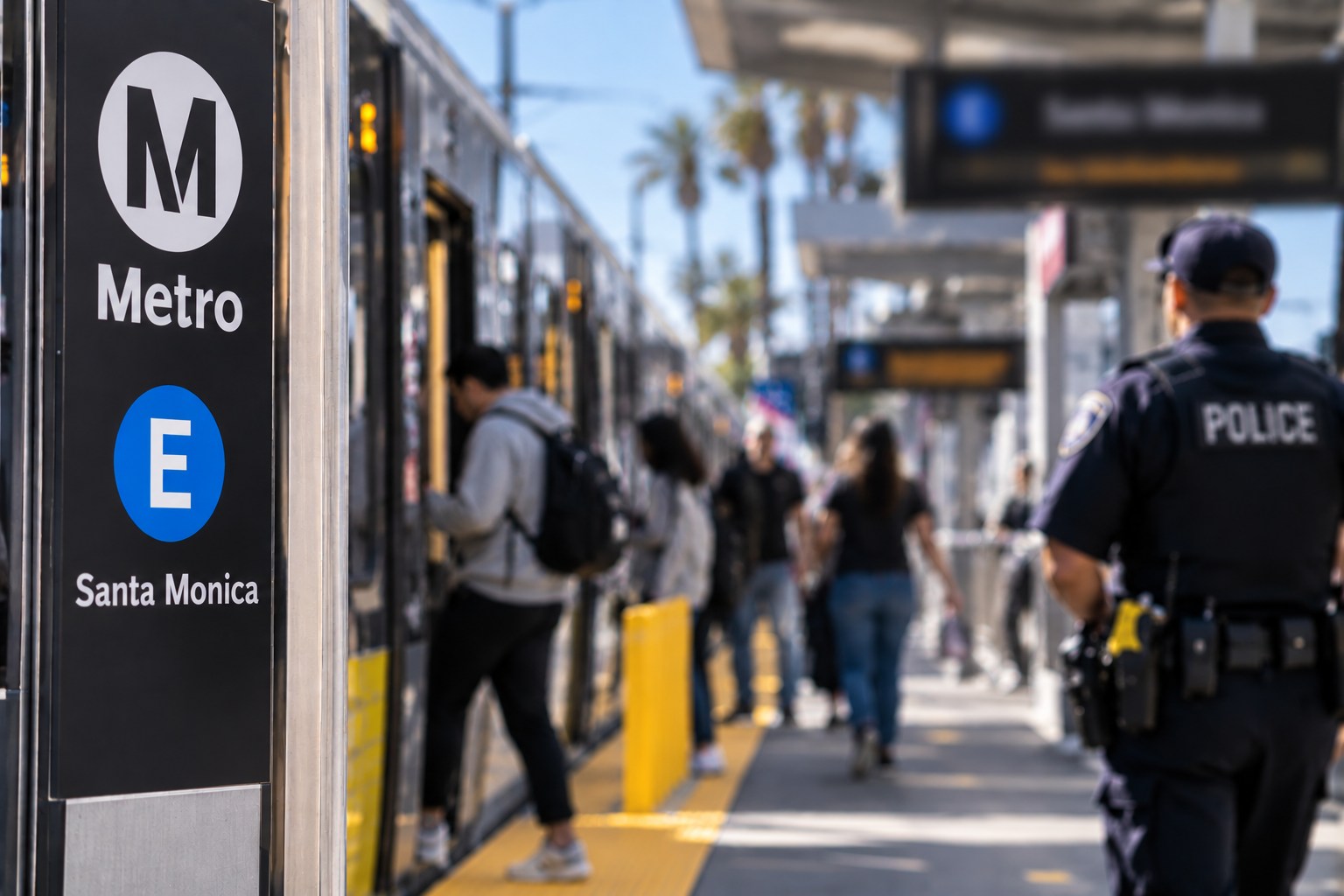
LOS ANGELES, CA – Santa Monica is nearing an agreement with Metro that would allow Santa Monica Police Department officers to patrol the platforms and other Metro property at the city’s three E Line stations, expanding the local police presence on the transit system.
City leaders say the proposed partnership is intended to address public safety and quality-of-life concerns more directly while allowing officers to respond to incidents in areas that are currently under Metro’s jurisdiction.
The three Santa Monica E Line stations are Downtown Santa Monica, 17th Street/SMC and 26th Street/Bergamot, according to Metro’s station information. The E Line connects Santa Monica with East Los Angeles.
Agreement would expand SMPD’s presence
Santa Monica Councilmember Lana Negrete said the city’s police officers currently face jurisdictional limitations when dealing with incidents on Metro property.
Under the proposed agreement, Santa Monica Police Department officers would be authorized to ride trains, patrol Metro property and operate on station platforms within the city.
The arrangement would expand the areas in which local officers could directly intervene in situations ranging from disorderly conduct and fare-related violations to other public safety concerns.
The Santa Monica Police Department said the proposed partnership is being finalized with Metro and its Department of Public Safety.
In a statement, the department said the agreement would expand SMPD patrols at all three Santa Monica E Line stations, including the platforms, while improving coordination on crime and public safety issues.
The department also said officers would be able to connect people experiencing difficulties with appropriate services.
City says transit safety is part of broader effort
Negrete said the city’s concerns extend beyond traditional criminal activity.
She pointed to cleanliness, quality-of-life issues and other problems occurring around the stations as reasons for expanding the city’s ability to respond directly.
The proposed arrangement would also allow officers to connect people who need assistance with care-based services rather than relying exclusively on enforcement.
That approach would operate alongside Metro’s existing network of law enforcement partners, ambassadors and other public-safety personnel.
Metro currently contracts with city and county law enforcement agencies to patrol its buses, trains and stations. The agency says those partners provide a visible presence, respond to incidents, enforce the Metro code of conduct and conduct fare checks.
Metro is developing its own public safety department
The proposed Santa Monica agreement comes as Metro is also expanding its own public safety structure.
Metro says its Department of Public Safety is being developed as a coordinated system that combines transit policing, physical security, crisis intervention and community-based services.
Metro Chief of Police and Emergency Management Bill Scott joined the agency in 2025 as its inaugural chief, and the agency says the new department is intended to integrate several public safety functions across the transit system.
For now, however, Metro continues to rely on contracted law enforcement partners, including the Los Angeles Police Department and Los Angeles County Sheriff’s Department.
Metro reported that in 2025 its contracted law enforcement partners conducted approximately 123,000 bus boardings and more than 116,000 train boardings, while performing about 500,000 TAP card inspections. The agency said enforcement activity resulted in more than 2,300 arrests for criminal activity and outstanding warrants.
The Santa Monica agreement would add the city’s own police department to that broader network of transit safety resources at stations inside the city.
Santa Monica has already pursued additional Metro security measures
The city has previously worked with Metro on measures intended to address safety and fare compliance at its stations.
In September 2024, Metro expanded its TAP-to-Exit program to the Downtown Santa Monica E Line station. The system requires riders to validate their TAP cards when leaving the station. Santa Monica officials described the move as part of a broader effort to improve safety and reduce unauthorized use of the transit system.
Metro later expanded TAP-to-Exit to additional end-of-line stations and has continued installing physical security improvements, including taller fare gates at selected stations.
The Downtown Santa Monica station was the first Southern California location selected for the TAP-to-Exit expansion after Metro’s initial pilot at North Hollywood.
Three stations would be covered
The proposed police partnership would cover all three E Line stations located in Santa Monica.
Downtown Santa Monica is near the Third Street Promenade, Santa Monica Pier, beach and Civic Center.
17th Street/SMC serves Santa Monica College and surrounding neighborhoods.
26th Street/Bergamot is located near the Bergamot Station arts complex and nearby commercial and office areas.
Metro’s current E Line information identifies all three as Santa Monica stations.
The geographic arrangement is significant because the E Line crosses several jurisdictions between Santa Monica and East Los Angeles. Local police departments can operate within their own municipal jurisdictions, while Metro property and transit operations are governed separately.
The proposed agreement would establish clearer authority for SMPD officers to work directly on the Metro portions of the system within Santa Monica.
Police presence would include more than enforcement
Santa Monica officials have emphasized that the proposed partnership is not limited to arrests or traditional police activity.
The city’s police department said the arrangement would support coordination on crime and public safety while helping officers connect people in need with appropriate services.
That approach is consistent with Metro’s current public safety structure, which includes unarmed crisis-response teams, community intervention specialists, ambassadors and other personnel in addition to sworn law enforcement.
Metro says its Community Intervention Specialists focus on prevention and de-escalation, while its ambassadors assist riders and report problems they encounter.
The combination means that a person experiencing a behavioral health, homelessness or other service-related issue could potentially encounter multiple types of personnel depending on the circumstances.
Metro says discussions are continuing
Metro confirmed that it is discussing the proposed partnership with Santa Monica but said additional details have not yet been finalized.
The agency said it is having productive discussions with the city about how to support safe and welcoming stations but that it is too early to release further details about the agreement.
That means several operational questions remain open, including the precise scope of the patrols, when officers would begin operating under the agreement and how the local police presence would coordinate with Metro’s existing public safety personnel.
The Santa Monica Police Department likewise said additional details would be released once the agreement and implementation plans are finalized.
What happens next
The next step is completion of the partnership between Santa Monica and Metro.
If finalized, the agreement would allow SMPD officers to patrol Metro platforms and other Metro property at the city’s three E Line stations, giving local officers a more direct role in responding to incidents on the system.
The arrangement would also add another layer to Metro’s existing public safety network, which currently includes contracted law enforcement, Metro’s Department of Public Safety, ambassadors and community-based personnel.
Information gathered by Street People indicates that the agreement remains in the finalization stage. Neither Santa Monica nor Metro has yet released the full operational terms, so the exact deployment schedule and responsibilities will depend on the final agreement.
For riders, the proposed change would mean a more visible Santa Monica police presence at the E Line stations as the city and Metro continue working on transit safety, fare compliance and connections to support services.