











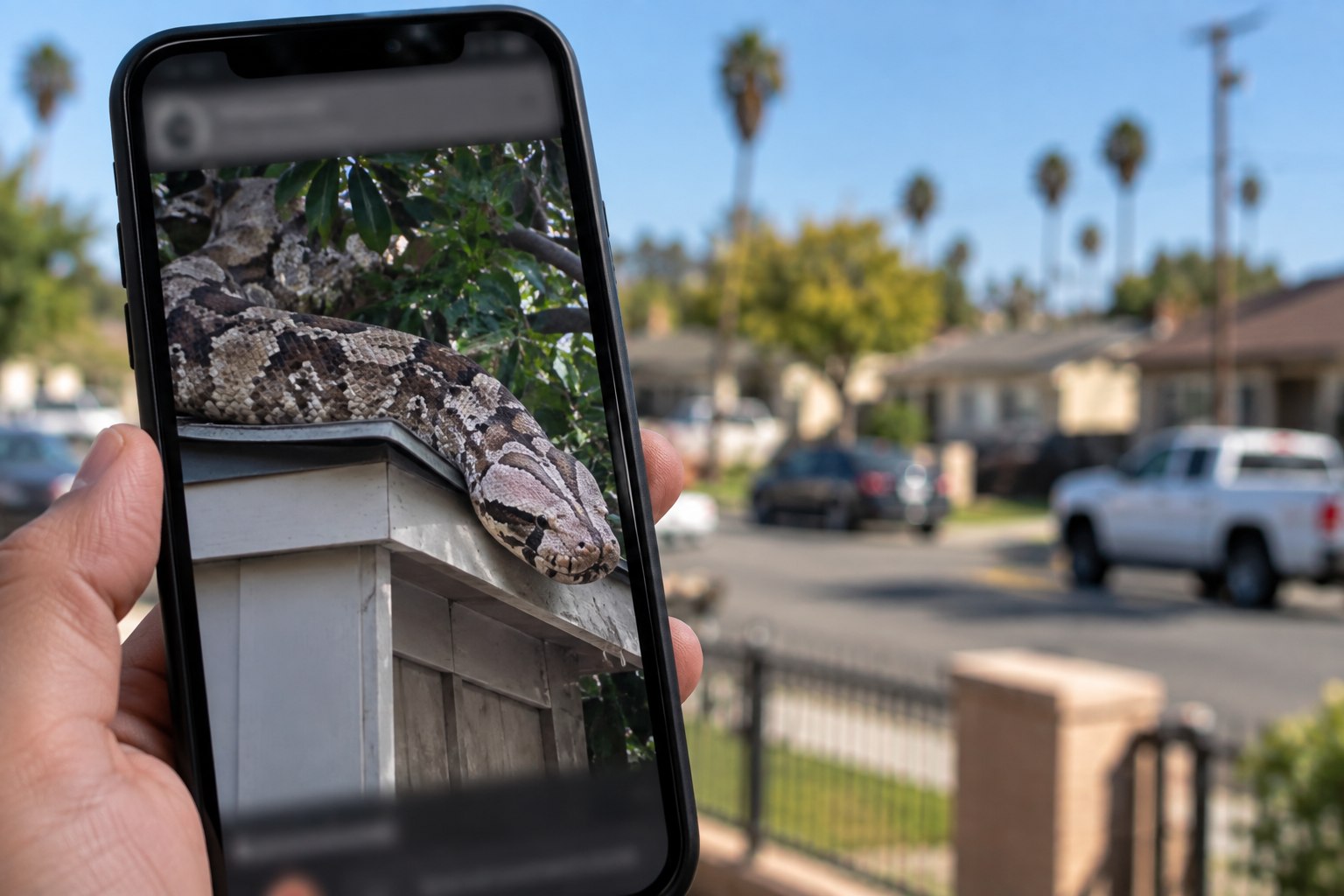
LOS ANGELES, CA – A frightening report of a highly venomous Gaboon viper roaming a Santa Ana neighborhood turned out to be a hoax after police determined that the image used to report the snake was generated with artificial intelligence.
The Santa Ana Police Department initially treated the report seriously after receiving an image that appeared to show a large Gaboon viper in a residential area near Main Street and Edinger Avenue.
Officers and reptile experts searched the area after the report was made, but investigators found no snake and no physical evidence indicating that a Gaboon viper had been there.
The reporting party later admitted during a follow-up investigation that the image was AI-generated and that the report itself was false.
Police initially warned residents about the snake
The original report prompted a public warning because a Gaboon viper is not a typical snake found in Southern California.
Police said the animal shown in the image was believed to be approximately 4 to 5 feet long and highly venomous. The department advised residents not to approach or attempt to handle the animal if they encountered a snake matching the description.
The warning remained in place while officers and reptile specialists worked to determine whether the animal was actually present.
That search ultimately produced no evidence of a Gaboon viper in the neighborhood.
According to information released by the police department, experts who responded to the area also questioned the image itself and the circumstances depicted in it.
The image raised questions from the beginning
One of the biggest concerns involved where the snake appeared to be positioned.
Gaboon vipers are heavy-bodied snakes that generally spend their time on the ground. The reported image appeared to show the animal elevated on or near a shed and supported by a relatively thin tree branch.
That detail immediately raised questions among reptile experts about whether the scene was biologically plausible.
The concern was significant enough that police did not simply rely on the image when deciding whether the public faced a potential threat. Instead, officers and reptile specialists searched the reported location directly.
That approach ultimately found no snake and no signs that the reported animal had been in the area.
Gaboon vipers are not native to California
The Gaboon viper, scientifically known as Bitis gabonica, is native to parts of sub-Saharan Africa rather than California.
Its presence in Santa Ana would therefore have represented an unusual exotic-animal situation rather than a normal wildlife encounter.
California also regulates the possession of many exotic and restricted animals. The California Department of Fish and Wildlife says restricted species generally require permits for people who import, export, transport or possess them.
The department explains that restricted-species permits are issued for limited purposes and that California does not generally allow people to import or possess wild animals simply as pets.
That regulatory framework was another reason an alleged Gaboon viper in an Orange County residential neighborhood would have warranted attention from authorities.
Experts found no evidence of a snake
The search involved law enforcement personnel and reptile experts who examined the area where the animal was reportedly seen.
Nothing was found that confirmed the presence of the snake.
There was no Gaboon viper, and investigators did not find evidence consistent with a snake matching the description having been in the neighborhood.
That distinction became important because the original photograph had circulated as if it were evidence of an actual animal sighting.
Instead, investigators eventually determined that the photograph itself had been artificially created.
The reporting party admitted the image was fake
The case changed after detectives followed up with the person who had initially reported the snake.
During that follow-up, the person admitted that the photograph had been generated using artificial intelligence and that the report was false.
Santa Ana police said they had concerns about the authenticity of the photograph from the beginning, but the department still had to investigate because the possibility of a dangerous venomous snake could not simply be dismissed without checking the location.
The department’s response also highlights a growing difficulty for law enforcement: a realistic-looking image can create an apparent emergency before investigators have had an opportunity to determine whether the underlying event actually happened.
In this case, officers had to treat the report as potentially genuine until their investigation established otherwise.
No snake was found during the search
The outcome was ultimately far different from what residents had initially feared.
Instead of locating a dangerous exotic snake, officers and specialists determined that there was no evidence of the reported animal.
The California Department of Fish and Wildlife’s wildlife reporting resources provide residents with information for reporting wildlife sightings and other wildlife incidents, while the department’s enforcement division handles violations involving California’s wildlife laws.
For the Santa Ana neighborhood involved in the hoax, however, there was no confirmed wildlife emergency.
Police have not detailed possible charges
Santa Ana police have not publicly indicated that the person responsible for the false report has been charged.
The department said the investigation established that the image was AI-generated and that the report was false, but the available information does not establish what criminal or administrative action, if any, will follow.
The incident nevertheless required a police response and the involvement of reptile specialists because authorities initially had to consider the possibility that a highly venomous exotic snake was actually loose in a residential neighborhood.
The department ultimately thanked residents for their patience while officers and experts investigated the report.
The episode ended without a Gaboon viper being found, but it left police with a different problem to address: an AI-generated image had been convincing enough to trigger a real-world public safety response.